

Research Article
Received: 2026-06-14 | Revised:2026-08-10 | Accepted: 2026-08-10 | Published: 2026-08-14
Pages: 203-212
DOI: https://doi.org/10.58985/jeopc.2026.v04i02.85
Abstract
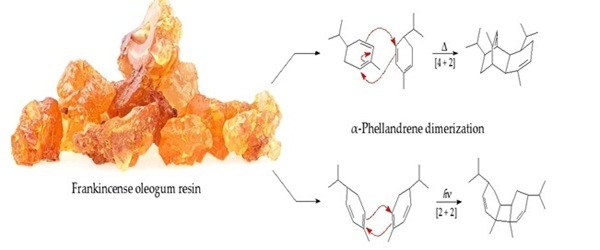
Frankincense oleogum resin essential
oils, rich in α-phellandrene, often contain small amounts of several
α-phellandrene dimers. The desert habitats of frankincense (Boswellia
spp.) trees expose the resins to both heat and sunlight, which could promote
the dimerization reactions of α-phellandrene. We hypothesized that thermally
and/or photochemically-allowed cycloaddition reactions account for the
formation of α-phellandrene dimers. In this study, the profiles of
α-phellandrene dimers from several Boswellia species were analyzed by
GC-MS and compared. In addition, both thermal and photochemical reactions of
α-phellandrene were carried out and the reaction mixtures were also analyzed by
GC-MS. These results, coupled with density functional theory (DFT) calculations
(ωB97X-D/6-31G*), suggest that photochemically allowed [2 + 2] cycloaddition
reactions are important contributors to the formation of α-phellandrene dimers
in frankincense essential oils. These results also contribute to the body of Boswellia
chemotaxonomic markers, particularly between B. sacra and B. carteri.
Keywords
Cycloaddition, pericyclic, thermally
allowed, photochemically allowed, frankincense, Boswellia, density
functional theory.
1. Introduction
Dimers of α-phellandrene are
conspicuous, albeit minor, components of frankincense (Boswellia Roxb.
ex Colebr. species) oleogum resin essential oils [1–9]. Indeed, at least eight different
α-phellandrene dimers have been detected in Boswellia volatiles [5]. The desert geographical locations of Boswellia
species expose the resins to both heat and sunlight, both of which might alter
resin chemistry. We hypothesize that either thermally or photochemically allowed
(or both) cycloaddition reactions account for the α-phellandrene dimers found
in frankincense essential oils. In order to shed some light on the dimers of
α-phellandrene, both thermal and photochemical dimerization reactions of
α-phellandrene were carried out. Based on the presence of α-phellandrene dimers
in several Boswellia essential oils, the purpose of this study is to
examine the distribution of α-phellandrene dimers and to carry out quantum
chemical calculations (ωB97X-D/6-31G*) on the
possible cycloaddition dimerization reactions. It has been pointed out that
density functional theory (DFT) calculations generally perform better than post
Hartree-Fock methods for pericyclic reactions [10, 11]. Additionally, we provide commentary
on the chemotaxonomic applications of α-phellandrene dimers to distinguish
between closely related species.
2.
Materials and methods
2.1. Thermal reaction of α-phellandrene
α-Phellandrene (63.8%, Sigma-Aldrich, St. Louis, MO, USA), 2 mL, was sealed in an NMR tube (Norell NRS5600HWIPV7 heavy-wall glass NMR tube, Sigma-Aldrich, St. Louis, MO, USA) and heated to 140-150 °C in a sand bath for 16 h. After the reaction, the NMR tube was opened and the reaction mixture analyzed by GC-MS (Table 1).
Table 1. α-Phellandrene dimers (relative distributions within the total detected dimer fraction) from Boswellia oleogum resin essential oils and thermal and photochemical reactions of α-phellandrene.
|
RI |
B. carteri (n = 12) |
B. frereana (n = 10) |
B. rivae (n = 8) |
B. sacra (n = 13) |
Thermal |
Photochemical |
|
1726 |
0.0 |
0.0 |
0.8 ± 1.3 |
0.2 ± 0.6 |
1.4 |
0.0 |
|
1735 |
0.2 ± 0.8 |
2.3 ± 0.3 |
0.3 ± 0.9 |
0.0 |
2.6 |
2.1 |
|
1740 |
0.0 |
0.1 ± 0.1 |
0.0 |
2.8 ± 3.0 |
0.8 |
0.0 |
|
1749 |
0.0 |
0.0 ± 0.1 |
0.0 |
0.1 ± 0.3 |
1.7 |
0.7 |
|
1761 |
0.0 |
0.0 |
0.7 ± 1.2 |
0.0 |
0.0 |
0.0 |
|
1766 |
0.0 |
0.2 ± 0.4 |
0.0 |
0.0 |
38.3 |
0.0 |
|
1774 |
0.0 |
0.1 ± 0.3 |
0.0 |
0.0 |
2.9 |
0.0 |
|
1781 |
0.0 |
0.2 ± 0.3 |
0.0 |
0.0 |
4.1 |
0.0 |
|
1794 |
46.0 ± 11.0 |
66.0 ± 1.5 |
70.8 ± 5.5 |
63.6 ± 9.0 |
3.7 |
63.3 |
|
1797 |
8.8 ± 5.1 |
0.1 ± 0.2 |
0.0 |
0.0 |
0.0 |
0.0 |
|
1801 |
5.3 ± 5.0 |
10.1 ± 1.9 |
10.5 ± 1.7 |
10.6 ± 2.1 |
4.2 |
6.1 |
|
1806 |
0.0 |
0.2 ± 0.3 |
0.0 |
0.0 |
17.0 |
0.0 |
|
1813 |
3.0 ± 5.5 |
1.6 ± 0.5 |
1.0 ± 0.8 |
2.4 ± 1.2 |
3.1 |
1.4 |
|
1825 |
1.0 ± 2.6 |
1.6 ± 0.3 |
1.1 ± 1.0 |
1.9 ± 0.8 |
0.0 |
1.4 |
|
1829 |
1.0 ± 2.6 |
9.3 ± 0.6 |
9.9 ± 0.6 |
8.9 ± 1.3 |
0.0 |
7.7 |
|
1832 |
0.0 |
0.7 ± 0.3 |
0.6 ± 0.5 |
0.3 ± 0.4 |
0.0 |
0.0 |
|
1839 |
0.0 |
0.8 ± 0.3 |
1.3 ± 2.0 |
0.9 ± 0.5 |
8.6 |
1.1 |
|
1864 |
4.5 ± 5.7 |
0.0 |
0.0 |
0.0 |
0.0 |
0.9 |
|
1868 |
3.4 ± 4.7 |
0.0 |
0.0 |
1.1 ± 1.2 |
0.0 |
0.0 |
|
1904 |
15.0 ± 6.2 |
0.0 |
0.0 |
4.5 ± 5.5 |
4.5 |
6.8 |
|
1906 |
1.0 ± 3.6 |
2.3 ± 1.6 |
0.2 ± 0.4 |
0.0 |
0.0 |
0.0 |
|
1912 |
8.8 ± 7.7 |
2.3 ± 1.0 |
2.2 ± 3.7 |
3.8 ± 3.0 |
2.2 |
5.3 |
RI = Experimentally determined retention index using the arithmetic formula of van den Dool and Kratz [14].
The α-phellandrene dimers used in the ANOVA comparison are highlighted in bold.
The Boswellia sample data taken from previously published studies (B. frereana, B. rivae, B. sacra) or
newly generated in the present study (B. carteri, B. sacra).
2.2. Photochemical reaction of α-phellandrene
α-Phellandrene (63.8%, Sigma-Aldrich,
St. Louis, MO, USA), 2 mL, was sealed in a quartz NMR tube (Wilmad Z562890
quartz NMR tube, Sigma-Aldrich, St. Louis, MO, USA) and exposed to UV radiation
(365 nm, 72 h) using a FisherBiotech UV lamp, model FBUVLS-80, (FisherBiotech,
Pittsburgh, PA, USA). After the reaction, the NMR tube was opened and the
reaction mixture analyzed by GC-MS (Table 1).
2.3. Hydrodistillation of Boswellia
oleogum resins
The oleogum resins of Boswellia
species were hydrodistilled as previously described [8,9,12,13].
2.4. Gas chromatography – mass
spectrometry (GC-MS)
The oleogum resins of Boswellia
species were analyzed by GC-MS. Instrument: Shimadzu GC-MS-QP2010 Ultra
(Shimadzu Scientific Instruments, Columbia, MD, USA). GC Column: Zebron ZB-5ms
fused silica capillary column (60 m ´ 0.25 mm ´
0.25 μm film thickness) (Phenomenex, Torrance, CA, USA). MS detector conditions:
Electron impact (EI) mode, electron energy = 70 eV, scan range = 40–400 atomic
mass units, scan rate = 3.0 scans/second. Carrier gas, conditions: Helium,
column head pressure = 208.3 kPa, flow rate = 2.00 mL/min. Injector, detector temperatures:
Injector temperature = 260 °C, interface temperature = 260 °C, ion source
temperature = 260 °C. GC oven temperature program: Initial temperature = 50 °C,
ramp 2 °C/min to 260 °C, hold 260 °C for 5 min. Sample concentration, volume injected:
5% (in dichloromethane), 0.1 μL volume. Split mode: 24.5 : 1.0. Retention index
values were calculated using the van den Dool and Kratz method [14]. Percentages of the essential oil
components were calculated based on peak integration without standardization.
2.5. Statistical analysis
Analysis of variance was conducted by
one-way ANOVA, followed by Tukey’s post hoc test using Minitab® 18
(Minitab Inc., State College, PA, USA). Differences at p < 0.05 were
considered to be statistically significant.
2.6. Computational methods
All calculations were carried out using
Spartan ’24 for Windows, v. 1.3.1 (Wavefunction, Inc., Irvine, CA, USA).
Initial conformational analyses were carried out on α-phellandrene and each of
the dimeric products using a Monte-Carlo molecular mechanics conformational
search using the MMFF force field [15]. For each compound, the lowest-energy
conformations from the MMFF conformational analysis were then modeled using
density functional theory with the ωB97X-D functional [16] and the 6-31G* basis set [17] for the optimization of the structures
in the gas phase as well as transition-state structures. Frequency calculations
were used to characterize stationary points as minima or first-order saddle
points. Considered to be one of the best hybrid generalized gradient
approximation (GGA) functionals [18], the ωB97X-D functional was selected
for this study.
3.
Results and discussion
Commercial α-phellandrene was analyzed by GC-MS and was found to be composed of 63.8% α-phellandrene, 35.9% other monoterpenoids and an unidentified diterpenoid (0.3%). The GC-MS data for commercial α-phellandrene are presented in Table 2. There were no α-phellandrene dimers detected in commercial α-phellandrene.
Table 2.
Chemical composition of commercial (Sigma-Aldrich, St. Louis, MO, USA) α-phellandrene.
|
RIcalc |
RIdb |
Compounds |
Composition (%) |
|
932 |
933 |
α-Pinene |
0.6 |
|
972 |
972 |
Sabinene |
0.4 |
|
977 |
978 |
β-Pinene |
2.6 |
|
989 |
989 |
Myrcene |
6.2 |
|
1000 |
1000 |
δ-2-Carene |
0.6 |
|
1008 |
1007 |
α-Phellandrene |
63.8 |
|
1017 |
1017 |
α-Terpinene |
2.3 |
|
1025 |
1025 |
p-Cymene |
8.6 |
|
1029 |
1030 |
Limonene |
1.5 |
|
1033 |
1032 |
1,8-Cineole |
10.8 |
|
1173 |
1173 |
Borneol |
0.5 |
|
1203 |
1202 |
cis-Sabinol |
1.5 |
|
1247 |
--- |
Unidentified monoterpenoid |
0.3 |
|
1826 |
--- |
Unidentified diterpenoid |
0.3 |
RIcalc = Retention index calculated with respect to a homologous series of n-alkanes on a ZB-5ms column.
RIdb = Reference retention index from the
databases.
Dimerization reactions of α-phellandrene led to a total of 17 compounds with mass spectra (Fig. 1) consistent with dimers of α-phellandrene (Table 1). Treatment of commercial α-phellandrene, 140-150 °C for 16 h, resulted in the formation of small amounts of α-phellandrene dimers (2.9% of the total composition) (Table 1). The major α-phellandrene dimers from the thermal treatment had RI values of 1766 (38.3%), 1806 (17.1%), and 1829 (8.6%). Conversely, the photochemical reaction of α-phellandrene under UV light gave a very different profile of α-phellandrene dimers with RI 1794 (63.3%) dominating along with RI 1801 (6.1%), RI 1829 (7.7%), RI 1904 (6.8%), and RI 1912 (5.3%) (Table 1). The yield of α-phellandrene dimers after UV treatment of α-phellandrene was 3.1%.

Figure 1. Mass spectrum of α-phellandrene dimer from the photochemical reaction (RI 1794).
Note: Mass spectra of all α-phellandrene dimers are similar: MS(EI): 136(35%), 93(100%), 92(60%), 77(15%), 43(7%). A molecular ion at m/z 272 was not observed; each dimer undergoes retro-cycloaddition under MS conditions to give a spectrum that looks like α-phellandrene. This phenomenon is sometimes observed for retro-pericyclic reactions [19].
Most of these dimers were also observed in Boswellia oleo-gum resin essential oils, including B. frereana Birdw. from Somaliland [7], B. rivae Engl. from Ethiopia [8], B. sacra Flück. from Oman [9], and B. carteri Birdw. from Somaliland. Although World Flora Online [20] considers B. carteri to be a synonym of B. sacra, we use B. carteri here to refer to the Somalia populations of B. sacra due to the distinct chemistry, research history, and market positioning. Not surprisingly, there are several Boswellia species that did not show the presence of α-phellandrene dimers, including B. dalzielii Hutch. [13, 21], B. occulta Thulin, DeCarlo, & S.P. Johnson [22, 23], B. ogadensis Vollesen [24], and B. papyrifera (Delile) Hochst. [25], which can be attributed to the low concentrations (only trace amounts) of α-phellandrene.
The major α-phellandrene dimers in the Boswellia (B. carteri, B. frereana, B. rivae, B. sacra) essential oils were RI 1794, RI 1797, RI 1801, RI 1829, RI 1864, RI 1904, and RI 1912, which are summarized in Table 1. The distributions of the α-phellandrene dimers were similar for B. frereana, B. rivae, and B. sacra, but B. carteri showed a significantly different profile (Fig. 2 shows the ANOVA (Tukey) comparison between the distributions of α-phellandrene dimers in Boswellia oleogum essential oils). The distributions of α-phellandrene dimers in the resin essential oils of Boswellia species do not correspond to the distribution from the thermal reaction. However, the photochemical reaction of α-phellandrene does show some similarities (Table 1).

Figure 2. Distributions of major α-phellandrene dimers in Boswellia oleogum resin essential oils.
Compounds with the same letter for each dimer are not significantly different (p > 0.05, ANOVA, Tukey).
It has long been debated whether B. sacra (growing in southern Arabia) and B. carteri (growing in Somalia and Somaliland) are the same or are different species. It is generally recognized botanically as one variable species under the name B. sacra, but chemists in particular continue to dispute this classification given the often-pronounced differences in oleo-gum resin essential oil composition and chirality [26, 27]. These results follow the same pattern, with RI 1794, RI 1797, RI 1801, RI 1829, and RI 1864 in particular being useful for distinguishing between the two “species”. While this doesn’t prove speciation, it contributes to the growing set of chemical markers differentiating their oleo-gum resins.
The energies of the [4 + 2] and [2 + 2] cycloaddition dimerization reactions for α-phellandrene were calculated using density functional theory (DFT) at the ωB97X-D/6-31G* level. There are eight possible [4 + 2] cycloaddition dimerization reactions for α-phellandrene. The products from these eight [4 + 2] cycloadditions are shown in Fig. 3. Based on the thermodynamic stabilities and the transition-state energies for the [4 + 2] cycloaddition reactions, there are four major [4 + 2] cycloaddition dimers (A, B, C, and D). Based on both the transition-state energies and the relative energies of the final dimeric products, formation of dimer D is the lowest-energy path for the thermal [4 + 2] dimerization of α-phellandrene. The reaction profile for dimer D is shown in Fig. 4.

Figure 3. α-Phellandrene dimers from [4 + 2] cycloaddition reactions of α-phellandrene.
ΔE = Electronic energies (kcal/mol, ωB97X-D/6-31G*) relative to two monomeric α-phellandrenes and Boltzmann distribution based on ΔE (298.15 K). ΔE‡ = Transition-state energies (kcal/mol) and the corresponding Boltzmann distributions.

Figure 4. Reaction profile (ωB97X-D/6-31G*) for the thermally-allowed [4 + 2] cycloaddition reaction leading to formation of dimer D.
In the doctoral dissertation of Simla Basar [1], an α-phellandrene dimer from Boswellia frereana was isolated and characterized by 1H and 13C NMR spectroscopy. The NMR data were consistent with a [2 + 2] dimer of α-phellandrene. There are 4 possible [2 + 2] cycloadducts of α-phellandrene (Fig. 5). All of these have either mirror-plane or 2-fold symmetry, which is consistent with the NMR data.

Figure 5. α-Phellandrene dimers from thermal [2 + 2] cycloaddition reactions of α-phellandrene.
ΔE = Electronic energies (kcal/mol, ωB97X-D/6-31G*) relative to two monomeric α-phellandrenes and Boltzmann distribution based on ΔE (298.15 K). ΔE‡ = Transition-state energies (kcal/mol, ωB97X-D/6-31G*) and the corresponding Boltzmann distributions. a This is the structure proposed by Basar [1].
The dimeric structure shown in Basar’s dissertation [1] and re-iterated by Mertens and co-authors [3], however, is the highest-energy ground-state structure of the four possible cycloadducts (dimer I in Fig. 5). Based on the calculated thermodynamic characteristics, it is more likely that dimer L is the thermal [2 + 2] cycloadduct described by Basar. The transition-state energies shown in Fig. 5 are for the ground-state (thermal) cycloaddition. Thermal [2 + 2] cycloadditions are symmetry disallowed, which accounts for the relatively high transition-state energies compared to those for [4 + 2] cycloadditions. It does not rule out, however, a sequential rather than concerted dimerization mechanism.
The [2 + 2] cyclization is photochemically allowed. The calculated relative energies (relative to the energies of the ground-state monomers) of the singlet excited states for the four [2 + 2] dimers are 82.6 kcal/mol, 79.2 kcal/mol, 81.7 kcal/mol, and 103.4 kcal/mol for dimers I, J, K, and L (Fig. 6), respectively, which predicts a Boltzmann distribution of 98.3% for dimer J, even though the ground state energy of dimer L is lower (Fig. 5). Interestingly, however, the transition-state energies favor formation of [2 + 2] dimer I. The relative transition-state energies (ΔE‡, relative to the ground state monomers) are 106.6, 114.2, 126.8, and 123.9 kcal/mol for dimers I, J, K, and L, respectively. Dimer I is the dimer proposed by Basar [1]. Therefore, under kinetic control and photochemical conditions, dimer I is predicted to be the major product, but under thermodynamic control, dimer J should be preferred. The reaction profile for the photochemical [2 + 2] cycloaddition reaction of α-phellandrene forming dimers I and J is shown in Fig. 7.

Figure 6. α-Phellandrene dimers from photochemical [2 + 2] cycloaddition reactions of α-phellandrene.
ΔE = Electronic energies (kcal/mol, ωB97X-D/6-31G*) relative to two monomeric α-phellandrenes and Boltzmann distribution based on ΔE (298.15 K). ΔE‡ = Transition-state energies (kcal/mol, ωB97X-D/6-31G*) and the corresponding Boltzmann distributions.

Figure 7. Reaction profile (ωB97X-D/6-31G*) for the photochemically-allowed [2 + 2] cycloaddition reaction leading to formation of dimers I and J.
GS = ground state, hν = photochemical excitation, 1ES = singlet excited state.
Based on the general agreement of the distribution of α-phellandrene dimers from the photochemical reaction with those found in Boswellia oleogum resin essential oils, we can conclude that the results suggest that the major dimer in the essential oils is likely dimer I, the dimeric structure proposed by Basar [1], and results from exposure of the resin to sunlight.
4. Conclusions
Frankincense essential oils rich in α-phellandrene often contain small amounts of α-phellandrene dimers. The results of this study are consistent with the formation of several α-phellandrene dimers via photochemically-allowed [2 + 2] cycloaddition reactions; thermally-allowed [4 + 2] cycloaddition reactions appear less important. In addition, the [2 + 2] dimer proposed by Basar is consistent with the singlet excited-state [2 + 2] dimerization. There are several limitations to the present study. The computations were carried out in the gas phase (i.e., no solvent effects). The oleogum resin matrix may affect the reaction enthalpies. In addition to pericyclic cycloaddition mechanisms, other mechanisms for the dimerization may be possible. For example, it may be possible that other components in the Boswellia resins can act as triplet sensitizers, leading to diradical intermediates, which would further complicate the dimerization scenario. Future research should be carried out using higher-purity α-phellandrene for the dimerization, and to assign each α-phellandrene dimer to its corresponding RI value. Quantitative structure-retention relationship calculations may be useful.
Disclaimer (artificial intelligence)
Authors hereby state that no generative AI tools such as Large Language Models (ChatGPT, Copilot, etc.) and text-to-image generators were utilized in the preparation or editing of this manuscript.
Authors’ contributions
Conceptualization, W.N.S.; methodology, P.S., W.N.S.; validation, P.S., W.N.S.; formal analysis, P.S., W.N.S.; investigation, P.S., S.J., A.D., W.N.S.; resources, P.S., S.J., W.N.S.; data curation, W.N.S.; writing—original draft preparation, S.J., W.N.S.; writing—review and editing, P.S., S.J., A.D., W.N.S.; visualization, W.N.S.; supervision, P.S., S.J., W.N.S.; project administration, S.J., W.N.S.
Acknowledgments
This work was carried out as part of the activities of the Aromatic Plant Research Center (APRC, https://aromaticplant.org/).
Funding
This research received no specific grant from any funding agency.
Availability of data and materials
All data will be made available on request according to the journal policy.
Conflicts of interest
The authors declare no conflicts of interest.
References
1. | Basar, S. Phytochemical Investigations on Boswellia Species, Dr. Rer. Nat. Dissertation, Universität Hamburg, 2005. |
2. | Hamm, S.; Bleton, J.; Connan, J.; Tchapla, A. A chemical investigation by headspace SPME and GC–MS of volatile and semi-volatile terpenes in various olibanum samples. Phytochemistry 2005, 66, 1499–1514. https://doi.org/10.1016/j.phytochem.2005.04.025 |
3. | Mertens, M.; Buettner, A.; Kirchhoff, E. The volatile constituents of frankincense – A review. Flavour Fragr. J. 2009, 24. 279–300. https://doi.org/10.1002/ffj.1942 |
4. | Mothana, R.A.A.; Hasson, S.S.; Schultze, W.; Mowitz, A.; Lindequist, U. Phytochemical composition and in vitro antimicrobial and antioxidant activities of essential oils of three endemic Soqotraen Boswellia species. Food Chem. 2011, 126, 1149–1154. https://doi.org/10.1016/j.foodchem.2010.11.150 |
5. | Niebler, J.; Buettner, A. Frankincense revisited, part 1: Comparative analysis of volatiles in commercially relevant Boswellia species. Chem. Biodivers. 2016, 13, 613–629. https://doi.org/10.1002/cbdv.201500329 |
6. | Satyal, P.; Pappas, R.S. First reporting on the chemistry and biological activity of a novel Boswellia chemotype: The methoxy alkane frankincense. Glob. J. Sci. Front. Res. B Chem. 2016, 16. |
7. | Johnson, S.; DeCarlo, A.; Satyal, P.; Dosoky, N.S.; Sorensen, A.; Setzer, W.N. The chemical composition of single-tree Boswellia frereana resin samples. Nat. Prod. Commun. 2021, 16, 1934578X211043727. https://doi.org/10.1177/1934578X211043727 |
8. | DeCarlo, A.; Johnson, S.; Abdikadir, A.; Satyal, P.; Poudel, A.; Setzer, W.N. Evaluating the potential of Boswellia rivae to provide sustainable livelihood benefits in eastern Ethiopia. Plants. 2023, 12 (10), 2024. https://doi.org/10.3390/plants12102024 |
9. | DeCarlo, A.; Johnson, S.; Agieb, S.; Satyal, P.; Sorensen, A.; Setzer, W.N. Compositional analysis of cultivated and wild-harvested Boswellia sacra frankincense resin essential oils in Oman. Chem. Biodivers. 2025, 22, e02268. https://doi.org/10.1002/cbdv.202502268 |
10. | Guner, V.; Khuong, K.S.; Leach, A.G.; Lee, P.S.; Bartberger, M.D.; Houk, K.N. A standard set of pericyclic reactions of hydrocarbons for the benchmarking of computational methods: The performance of ab initio, density functional, CASSCF, CASPT2, and CBS-QB3 methods for the prediction of activation barriers, reaction energetics, and transition state geometries. J. Phys. Chem. A 2003, 107, 11445–11459. https://doi.org/10.1021/jp035501w |
11. | Ess, D.H.; Houk, K.N. Activation energies of pericyclic reactions: Performance of DFT, MP2, and CBS-QB3 methods for the prediction of activation barriers and reaction energetics of 1,3-dipolar cycloadditions, and revised activation enthalpies for a standard set of hydrocarbon pericyclic reactions. J. Phys. Chem. A 2005, 109, 9542–9553. https://doi.org/10.1021/jp052504v |
12. | DeCarlo, A.; Johnson, S.; Poudel, A.; Satyal, P.; Bangerter, L.; Setzer, W.N. Chemical variation in essential oils from the oleo-gum resin of Boswellia carteri: A preliminary investigation. Chem. Biodivers. 2018, 15, e1800047. https://doi.org/10.1002/cbdv.201800047 |
13. | DeCarlo, A.; Johnson, S.; Okeke-Agulu, K.I.; Dosoky, N.S.; Wax, S.J.; Owolabi, M.S.; Setzer, W.N. Compositional analysis of the essential oil of Boswellia dalzielii frankincense from West Africa reveals two major chemotypes. Phytochem. 2019, 164, 24–32. https://doi.org/10.1016/j.phytochem.2019.04.015 |
14. | van den Dool, H.; Kratz, P.D. A generalization of the retention index system including linear temperature programmed gas-liquid partition chromatography. J. Chromatogr. A 1963, 11, 463–471. https://doi.org/10.1016/S0021-9673(01)80947-X |
15. | Halgren, T.A. Merck Molecular Force Field. I. Basis, form, scope, parameterization, and performance of MMFF94. J. Comput. Chem. 1996, 17, 490–519. https://doi.org/10.1002/(sici)1096-987x(199604)17:5/6<490::aid-jcc1>3.0.co;2-p |
16. | Chai, J.D.; Head-Gordon, M. Long-range corrected hybrid density functionals with damped atom-atom dispersion corrections. Phys. Chem. Chem. Phys. 2008, 10, 6615–6620. https://doi.org/10.1039/b810189b |
17. | Hehre, W.J. A Guide to Molecular Mechanics and Quantum Chemical Calculations; Wavefunction, Inc.: Irvine, California, USA, 2003. ISBN 1-890661-18-X |
18. | Mardirossian, N.; Head-Gordon, M. Thirty years of density functional theory in computational chemistry: An overview and extensive assessment of 200 density functionals. Mol. Phys. 2017, 115, 2315–2372. https://doi.org/10.1080/00268976.2017.1333644 |
19. | Tureček, F.; Hanuš, V. Retro-Diels-Alder reaction in mass spectrometry. Mass Spectrom. Rev. 1984, 3, 85-152. https://doi.org/10.1002/mas.1280030104 |
20. | World Flora Online, W.F.O. An Online Flora of All Known Plants Available online: https://www.worldfloraonline.org/ (accessed on 26 May 2026) |
21. | DeCarlo, A.; Johnson, S.; Ouédraogo, A.; Dosoky, N.S.; Setzer, W.N. Chemical composition of the oleogum resin essential oils of Boswellia dalzielii from Burkina Faso. Plants 2019, 8, 223. https://doi.org/10.3390/plants8070223 |
22. | Johnson, S.; DeCarlo, A.; Satyal, P.; Dosoky, N.S.; Sorensen, A.; Setzer, W.N. The chemical composition of Boswellia occulta oleogum resin essential oils. Nat. Prod. Commun. 2019, 14, 1934578x19866307. https://doi.org/10.1177/1934578X19866307 |
23. | Johnson, S.; DeCarlo, A.; Satyal, P.; Dosoky, N.S.; Sorensen, A.; Setzer, W.N. Organic certification is not enough: The case of the methoxydecane frankincense. Plants 2019, 8, 88. https://doi.org/10.3390/plants8040088 |
24. | Johnson, S.; Abdikadir, A.; Satyal, P.; Poudel, A.; Setzer, W.N. Conservation assessment and chemistry of Boswellia ogadensis, a critically endangered frankincense tree. Plants 2022, 11, 3381. https://doi.org/10.3390/plants11233381 |
25. | DeCarlo, A.; Agieb, S.; Johnson, S.; Satyal, P.; Setzer, W.N. Inter-tree variation in the chemical composition of Boswellia papyrifera oleo-gum-resin. Nat. Prod. Commun. 2022, 17, 1934578X221117411. https://doi.org/10.1177/1934578X221117411 |
26. | Thulin, M. The Genus Boswellia (Burseraceae): The Frankincense Trees; Acta Universitatis Upsaliensis: Uppsala, Sweden, 2020. ISBN 915130886X, 9789151308869 |
27. | Woolley, C.L.; Suhail, M.M.; Smith, B.L.; Boren, K.E.; Taylor, L.C.; Schreuder, M.F.; Chai, J.K.; Casabianca, H.; Haq, S.; Lin, H.K.; et al. Chemical differentiation of Boswellia sacra and Boswellia carterii essential oils by gas chromatography and chiral gas chromatography-mass spectrometry. J. Chromatogr. A 2012, 1261, 158–163. https://doi.org/10.1016/j.chroma.2012.06.073 |

This work is licensed under the
Creative Commons Attribution
4.0
License (CC BY-NC 4.0).
Abstract
Frankincense oleogum resin essential
oils, rich in α-phellandrene, often contain small amounts of several
α-phellandrene dimers. The desert habitats of frankincense (Boswellia
spp.) trees expose the resins to both heat and sunlight, which could promote
the dimerization reactions of α-phellandrene. We hypothesized that thermally
and/or photochemically-allowed cycloaddition reactions account for the
formation of α-phellandrene dimers. In this study, the profiles of
α-phellandrene dimers from several Boswellia species were analyzed by
GC-MS and compared. In addition, both thermal and photochemical reactions of
α-phellandrene were carried out and the reaction mixtures were also analyzed by
GC-MS. These results, coupled with density functional theory (DFT) calculations
(ωB97X-D/6-31G*), suggest that photochemically allowed [2 + 2] cycloaddition
reactions are important contributors to the formation of α-phellandrene dimers
in frankincense essential oils. These results also contribute to the body of Boswellia
chemotaxonomic markers, particularly between B. sacra and B. carteri.
Abstract Keywords
Cycloaddition, pericyclic, thermally
allowed, photochemically allowed, frankincense, Boswellia, density
functional theory.
This work is licensed under the
Creative Commons Attribution
4.0
License (CC BY-NC 4.0).
Editor-in-Chief


This work is licensed under the
Creative Commons Attribution 4.0
License.(CC BY-NC 4.0).