

Research Article
Received: 2026-06-12 | Revised:2026-06-30 | Accepted: 2026-07-01 | Published: 2026-07-30
Pages: 188-202
DOI: https://doi.org/10.58985/jeopc.2026.v04i02.84
Abstract
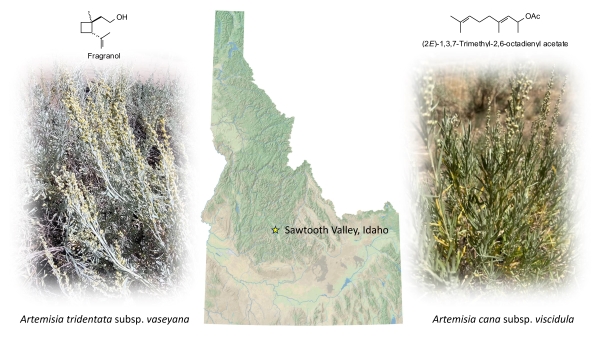
Sagebrush species, including Artemisia tridentata, Artemisia ludoviciana, Artemisia frigida, and Artemisia cana, are conspicuous features of the intermountain western region of North America. As part of our interest in the volatile phytochemistry of aromatic and medicinal plants, including sagebrush, of the western United States, we obtained and analyzed the essential oils of Artemisia tridentata subsp. vaseyana and Artemisia cana subsp. viscidula from the Sawtooth Valley of central Idaho. Essential oils were obtained by hydrodistillation and analyzed by gas chromatography – mass spectrometry. The essential oil of A. tridentata subsp. vaseyana was dominated by fragranol (55.8-70.0%) and fragranyl acetate (24.1-30.0%). The major components of A. cana subsp. viscidula were (2E)-1,3,7-trimethyl-2,6-octadienyl acetate (33.7-38.2%) and ethyl trans-chrysanthemumate (7.8-26.3%), along with two major unidentified components (4.8-12.1% and 6.1-8.5%). The essential oil compositions of these two sagebrush species are remarkably different from those previously published and illustrate the complexity and variability of sagebrush volatile components.
Keywords
Mountain big sagebrush, mountain silver sagebrush, fragranol, fragranyl acetate, 1,3,7-trimethyl-2,6-octadienyl acetate, ethyl trans-chrysanthemumate, chrysanthemal.
1. Introduction
A major ecoregion in the intermountain western United States is the sagebrush steppe (sagebrush-dominated semiarid high desert), which covers about 62.7 million hectares of the Great Basin and Colorado Plateau [1]. The region is characterized by cold winters, relatively low annual precipitation, and dominance of sagebrush (Artemisia species) cover and perennial grasses [2]. Common sagebrush species include Artemisia tridentata Nutt., Artemisia tripartita Rydb., Artemisia arbuscula Nutt., and Artemisia cana Pursh. Other common plant species in this ecoregion include shrubs, such as rabbitbrush (Ericameria nauseosa (Pursch) G.L. Nesom & G.I. Baird, Chrysothamnus viscidiflorus Nutt.) and bitterbrush (Purshia tridentata (Pursh) DC.) and forbs, such as balsamroot (Balsamorhiza sagittata (Pursh) Nutt.), yarrow (Achillea millefolium L.), Lomatium species, and Eriogonum species [1].
There are four subspecies of Artemisia tridentata Nutt. (big sagebrush, Asteraceae) currently recognized by World Flora Online (WFO): A. tridentata subsp. tridentata (Great Basin sagebrush), A. tridentata subsp. vaseyana (Rydb.) Beetle (mountain big sagebrush), A. tridentata subsp. wyomingensis Beetle & A.L. Young (Wyoming sagebrush), and A. tridentata subsp. parishii (A. Gray) H.M. Hall & Clem. (Parish sagebrush, Mojave sagebrush) [3]. Each A. tridentata subspecies occupies a distinct environment; however, hybridization can occur in intermediate zones [4, 5].
Mountain big sagebrush (A. tridentata subsp. vaseyana) ranges from British Columbia, Canada, south through Washington, Idaho, Montana, Oregon, Wyoming, California, Nevada, Utah, and Colorado, and into northern Arizona and New Mexico [6]. The plant is generally found in montane meadows and forests at elevations of 2000-2800 m. It is a medium-sized shrub, around 0.4-0.8 m tall. The leaves are 12-35 mm long, 2-3 mm wide, with three shallow lobes; the flower stalks are prominent paniculiform arrays, 10-15 cm long [6] (Fig. 1).

Figure 1. Artemisia tridentata subsp. vaseyana (Rydb.) Beetle.
A: Photograph of the plant taken at the time of collection.
B: Scan of a pressed sample.
Volatiles from A. tridentata subsp. vaseyana have been previously studied in southwestern Montana (major components α-pinene, 1,8-cineole, camphor, and two unidentified monoterpenoids) [7], central Utah (major components 1,8-cineole, trans-3-(1-oxo-2-methyl-2-propenyl)-2,2- dimethylcyclopropylmethanol, 2,2-dimethyl-6-isopropenyl-2H-pyran, 2,3-dimethyl-6-isopropyl-4H-pyran, thujone, sabinol, chrysanthemol, chrysanthemyl acetate, fragranyl acetate, fragranol, and 2-isopropenyl-5-methylhexa-(E)-3,5-dien-1-ol) [8], north-central Wyoming (major components, α-pinene, camphene, 1,8-cineole, camphor, fragranol, and grandisol) [9], and southwestern Idaho (major components 1,8-cineole, α-thujone, and camphor) [10]. The present study represents the first collection and analysis of A. tridentata subsp. vaseyana from the Sawtooth Valley of central Idaho. We hypothesized that the geographical remoteness of this collection from those from Utah or Montana likely exhibited a different chemical profile from previous reports.
Artemisia cana Pursh (silver sagebrush, Asteraceae) is an aromatic shrub found in the grasslands, floodplains, and montane forests of the western United States and Canada [6, 11, 12]. There are three subspecies of A. cana: A. cana subsp. cana (plains silver sagebrush), A. cana subsp. bolanderi (A. Gray) G.H. Ward (Bolander’s silver sagebrush), and A. cana subsp. viscidula (Osterh.) Beetles (mountain silver sagebrush) [3]. Plains silver sagebrush is generally found east of the Continental Divide, including western Canada (Manitoba, Saskatchewan, Nebraska, Alberta and British Columbia) and the northwestern United States (North Dakota, South Dakota, Nebraska, Montana, Wyoming, Colorado). The range of Bolander’s silver sagebrush is generally restricted to the enclosed basins of central Oregon and eastern California. Mountain silver sagebrush inhabits mountainous regions (approximately 1,800 m or higher) of southern Idaho, southwestern Wyoming, eastern Nevada, south along the Continental Divide, northern New Mexico and northern Arizona [13]. The plant generally grows 0.1-0.3 m tall, with linear-oblanceolate, entire leaves measuring 1-5 mm wide and up to 7 cm long, and covered with a silvery-white pubescence. The flower heads are arranged into congested, leafy panicles, sometimes reduced to a raceme or spike-like inflorescence [6, 11, 12] (Fig. 2).

Figure 2. Artemisia cana subsp. viscidula (Osterh.) Beetle.
A: Photograph of the plant taken at the time of collection.
B: Scan of a pressed sample.
Previous investigations of Artemisia cana subsp. cana have shown that the essential oils are dominated by 1,8-cineole and camphor [9,14,15]. Gundawardena and co-workers isolated and identified santolina triene, artemisia triene, artemiseole, 1,8-cineole, camphor, α-pinene, lyratal, isolyratol, lyratol, chrysanthemol, trans-chrysanthemal, chrysanthemyl acetate, fragranyl acetate, fragranol, 2-isopropenyl-5-methyl-(E)-hexa-3,5-dien-1-ol, 2,2-dimethyl-6-isopropenyl-2H-pyran, 2,3-dimethyl-6-isopropyl-4H-pyran, 2,4-diisopropenyl-5H-furan, and rothrockene from a pentane extract of A. cana subsp. viscidula [8]. However, the volatile chemical composition was not quantified. To the best of our knowledge this is the first report on the essential oil composition of A. cana subsp. viscidula growing in the Sawtooth Valley of central Idaho. We hypothesized that the chemical composition would differ from that of A. cana subsp. cana. As part of our interest in the volatile phytochemistry of aromatic and medicinal plants, we obtained and analyzed the essential oils from Artemisia tridentata subsp. vaseyana and Artemisia cana subsp. viscidula, which were growing in the Sawtooth Valley of central Idaho, and compared and contrasted the essential oil compositions with previous reports on these sagebrush species.
2. Materials and methods
2.1. Plant Material
The aerial parts of A. tridentata subsp. vaseyana and A. cana subsp. viscidula were collected from several plants growing in the Sawtooth Valley of Idaho on 11 October, 2025, in the early afternoon (Table 1). Artemisia tridentata vaseyana samples #1-3 were collected at 1:50, 1:55, and 1:58 pm, respectively. Artemisia cana viscidula samples #1-4 were collected at 1:53, 2:03, 2:12, and 2:53 pm, respectively. The plants were identified in the field by W.N. Setzer and verified by comparison with herbarium samples from the New York Botanical Garden [16]. Voucher specimens (WNS-Atv-2544 and WNS-Acv-5680) were deposited in the University of Alabama in Huntsville Herbarium. The fresh plant material was frozen after collection and stored frozen (‒20 °C) until processed. For each plant sample, the fresh/frozen plant material was chopped and then hydrodistilled using a Likens-Nickerson apparatus for four hours with continuous extraction of the distillate with dichloromethane. The solvent was evaporated from the distillate using a stream of warm air to obtain the essential oils (Table 1).
Table 1. Collection and hydrodistillation details of Artemisia tridentata subsp. vaseyana and Artemisia cana subsp. viscidula.
Sample | Location | Mass plant material (g) | Mass essential oil (g) | Essential oil color | Yield (%, w/w) |
Artemisia tridentata subsp. vaseyana | |||||
#1 | 44°2’46” N, 114°51’12” W, 2054 m asl | 52.80 | 2.40 | pale yellow | 4.55 |
#2 | 44°2’48” N, 114°51’13” W, 2050 m asl | 93.17 | 3.81 | pale yellow | 4.09 |
#3 | 44°2’48” N, 114°51’14” W, 2050 m asl | 39.53 | 2.07 | greenish-yellow | 5.24 |
Artemisia cana subsp. viscidula | |||||
#1 | 44°2’47” N, 114°51’13” W, 2053 m asl | 44.33 | 1.69 | pale yellow | 3.81 |
#2 | 44°2’48” N, 114°51’11” W, 2050 m asl | 71.03 | 2.82 | yellow | 3.98 |
#3 | 44°2’33” N, 114°50’28” W, 2057 m asl | 79.14 | 3.69 | yellow | 4.67 |
#4 | 44°2’33” N, 114°50’29” W, 2057 m asl | 82.01 | 3.14 | yellow | 3.83 |
2.2. Gas Chromatographic Analysis
The A. tridentata subsp. vaseyana and A. cana subsp. viscidula essential oils were analyzed by GC-MS using a Shimadzu GC-MS-QP2010 Ultra (Shimadzu Scientific Instruments, Columbia, MD, USA), fitted with a Zebron ZB-5ms fused silica capillary column (60 m ´ 0.25 mm ´ 0.25 μm film thickness) (Phenomenex, Torrance, CA, USA). The MS detector was operated in the electron impact (EI) mode with an electron energy of 70 eV, scan range of 40–400 atomic mass units, and scan rate of 3.0 scans/s. The injector, interface, and ion source temperatures were 260 °C. The GC oven was programed with an initial temperature of 50 °C, ramped at 2 °C/min to 260 °C, and held at 260 °C for 5 min. Each sample (0.1 μL of a 5% solution of essential oil in dichloromethane) was injected using a split mode (24.5:1). Retention indices were determined based on a series of homologous C8-C26 n-alkanes (Sigma-Aldrich, St. Louis, MO, USA) using the arithmetic method described by van den Dool and Kratz [17]. The identification of the essential oil components were determined by comparison of retention indices (within 5 RI units) and mass spectral fragmentation (similarity index > 80%) with those in the databases of Adams [18], Satyal [19], Mondello [20], NIST20 [21],and W23N23 [22]. The percentages of the essential oil components were calculated based on peak integration without standardization.
2.3. Multivariate Analyses
Hierarchical cluster analysis (HCA) and principal component analysis (PCA) were performed using XLSTAT v. 2018.1.1.62926 (Addinsoft, Paris, France). For the HCA, 18 A. tridentata subsp. vaseyana essential oil compositions from this study and previous publications [9,10] were treated as operational taxonomic units, and the percentages of the 14 most abundant essential oil components (α-pinene, camphene, artemiseole, 1,8-cineole, α-thujone, β-thujone, grandisol, chrysanthenone, trans-pinocarveol, camphor, trans-chrysanthemol, fragranol, ethyl trans-chrysanthemumate, and fragranyl acetate) were used to define the chemical associations between the A. tridentata subsp. vaseyana essential oil samples. Dissimilarity was used to determine clusters, considering the Euclidean distance, and Ward’s method was used to define agglomeration. PCA was performed for the visual verification of the essential oil interrelationships of the different A. tridentata subsp. vaseyana samples using 14 major components as variables with a Pearson correlation matrix. Both HCA and PCA for A. cana subspecies cana [9, 14, 15] and viscidula (this work) were carried out as described above using 10 major components (α-pinene, camphene, artemiseole, 1,8-cineole, santolina alcohol, cis-chrysanthemal, camphor, trans-chrysanthemol, ethyl trans-chrysanthemumate, and (2E)-1,3,7-trimethyl-2,6-octadienyl acetate).
3. Results and discussion
3.1. Chemical Composition of Artemisia tridentata subsp. vaseyana
The essential oils of A. tridentata subsp. vaseyana were obtained by hydrodistillation using a Likens-Nickerson apparatus, with yields of 4.09 5.24% (w/w). The Likens-Nickerson simultaneous distillation extraction method generally gives higher essential oil yields [23–26] and higher yields of volatile monoterpene hydrocarbons [23] that are prone to escape due to the high temperatures of boiling water [27] and water-soluble components [24, 28, 29] that would otherwise partition into the hydrosol [29]. Thus, the Likens-Nickerson method is appropriate for small amounts of plant material [26] and is often the best method to obtain the most representative oil with the highest overall recovery [29]. Gas chromatographic analysis of the essential oils identified 76 components, which accounted for 98.0-98.4% of the total composition. The essential oil compositions are compiled in Table 2. The essential oils were dominated by oxygenated monoterpenoids, predominantly fragranol (55.8-70.0%) and fragranyl esters (25.0-31.6%). A representative chromatogram of A. tridentata subsp. vaseyana is shown in Supplementary Fig. S1. Oxygenated monoterpenoids have generally dominated the essential oils of Artemisia tridentata [10, 30], including A. tridentata subsp. vaseyana [9,10], although the individual compositions are highly variable. Other sagebrush species, e.g., Artemisia ludoviciana Nutt [9, 14, 31–34], Artemisia frigida Willd [14, 35–40], and Artemisia longifolia Nutt. [9] are also rich in oxygenated monoterpenoids (Table 2).
Table 2. Essential oil compositions (percent of total composition) of Artemisia tridentata subsp. vaseyana from Sawtooth Valley, Idaho.
RIcalc | RIdb | Compounds | Area % | ||
#1 | #2 | #3 | |||
766 | 774 | Isobutyric acid | tr | tr | tr |
829 | 830 | Isovaleric acid | tr | tr | tr |
840 | 840 | 2-Methylbutanoic acid | tr | tr | tr |
848 | 846 | (Z)-Salvene | tr | tr | - |
850 | 850 | Propyl isobutyrate | - | - | tr |
850 | 850 | (2E)-Hexenal | tr | tr | tr |
880 | 878 | 3-Methyl-3-buten-1-yl acetate | tr | tr | tr |
914 | 913 | Isobutyl isobutyrate | tr | tr | tr |
920 | 920 | Prenyl acetate | tr | tr | tr |
923 | 923 | Tricyclene | - | tr | tr |
926 | 927 | α-Thujene | tr | tr | tr |
933 | 932 | α-Pinene | tr | 0.1 | 0.1 |
949 | 953 | Butyl isobutyrate | - | - | tr |
949 | 950 | Camphene | tr | 0.1 | tr |
961 | 960 | Benzaldehyde | tr | tr | tr |
972 | 972 | Sabinene | 0.1 | 0.2 | tr |
978 | 978 | β-Pinene | tr | 0.1 | tr |
989 | 989 | Myrcene | - | tr | tr |
990 | 990 | Dehydro-1,8-cineole | tr | 0.1 | tr |
1017 | 1018 | α-Terpinene | tr | tr | tr |
1022 | 1022 | Ethyl 3-methylbut-3-enyl carbonate | tr | tr | tr |
1025 | 1025 | p-Cymene | tr | tr | tr |
1029 | 1030 | Limonene | tr | tr | tr |
1031 | 1031 | 2-sec-Butylthiazole | tr | - | tr |
1032 | 1032 | 1,8-Cineole | 2.1 | 3.2 | 1.9 |
1043 | 1043 | Phenylacetaldehyde | 0.1 | tr | tr |
1052 | 1055 | Prenyl isobutyrate | - | tr | tr |
1058 | 1058 | γ-Terpinene | tr | 0.1 | tr |
1070 | 1069 | cis-Sabinene hydrate | tr | tr | tr |
1085 | 1086 | Terpinolene | tr | tr | tr |
1105 | 1104 | Nonanal | tr | - | tr |
1107 | 1105 | α-Thujone | 2.9 | 4.4 | 0.1 |
1111 | 1112 | cis-Rose oxide | tr | 0.1 | 0.1 |
1111 | 1113 | Phenethyl alcohol | tr | - | - |
1118 | 1118 | β-Thujone | 0.3 | 0.4 | - |
1119 | 1118 | Dehydrosabina ketone | tr | tr | - |
1126 | 1127 | trans-Rose oxide | tr | tr | 0.1 |
1127 | 1123 | Grandisol | tr | tr | 0.1 |
1137 | 1138 | Benzeneacetonitrile | tr | tr | tr |
1138 | 1140 | 3-Methylbutenyl 2-methylbutyrate | - | tr | - |
1138 | 1139 | Nopinone | tr | - | - |
1140 | 1140 | trans-Sabinol | tr | 0.1 | - |
1141 | 1141 | trans-Pinocarveol | tr | 0.1 | - |
1147 | 1145 | Camphor | - | 0.3 | tr |
1151 | 1152 | Nerol oxide | tr | - | - |
1162 | 1164 | Pinocarvone | tr | tr | tr |
1170 | 1170 | δ-Terpineol | tr | tr | tr |
1172 | 1173 | Borneol | - | 0.2 | - |
1180 | 1180 | Terpinen-4-ol | 0.1 | 0.2 | 0.1 |
1194 | 1199 | 3,9-Epoxy-p-mentha-1,8(10)-diene | tr | - | - |
1195 | 1195 | α-Terpineol | - | 0.1 | tr |
1220 | 1212 | Fragranol | 64.3 | 55.8 | 70.0 |
1284 | 1285 | Bornyl acetate | - | 0.2 | tr |
1288 | 1286 | trans-Sabinyl acetate | tr | 0.1 | - |
1320 | 1325 | Dihydrocarvyl acetate | tr | 0.1 | tr |
1346 | 1345 | Fragranyl acetate | 26.7 | 30.0 | 24.1 |
1354 | 1361 | Neryl acetate | 0.1 | 0.2 | 0.1 |
1380 | 1375 | α-Copaene | 0.1 | tr | 0.1 |
1388 | 1391 | β-Bourbonene | - | - | tr |
1423 | 1424 | (E)-β-Caryophyllene | 0.3 | 0.1 | tr |
1441 | 1441 | Fragranyl propionate | 0.3 | 1.0 | 0.4 |
1445 | 1448 | Neryl propionate | - | tr | tr |
1481 | 1482 | γ-Curcumene | 0.1 | 0.1 | 0.1 |
1484 | 1484 | Fragranyl isobutyrate | 0.2 | 0.2 | 0.4 |
1484 | 1480 | Germacrene D | 0.2 | 0.2 | 0.2 |
1499 | 1497 | Bicyclogermacrene | tr | 0.1 | 0.1 |
1499 | 1497 | α-Selinene | - | - | tr |
1507 | 1507 | Geranyl isobutyrate | - | 0.1 | 0.1 |
1521 | 1518 | δ-Cadinene | tr | 0.1 | tr |
1574 | 1575 | Fragranyl 2-methylbutyrate | 0.2 | 0.3 | 0.1 |
1578 | --- | Fragranyl isovaleratea | tr | 0.1 | tr |
1580 | 1576 | Spathulenol | 0.1 | 0.1 | 0.1 |
1584 | 1587 | Caryophyllene oxide | 0.1 | tr | tr |
1628 | 1632 | Muurola-4,10(14)-dien-1β-ol | 0.1 | 0.1 | - |
1658 | 1655 | α-Cadinol | tr | tr | tr |
1951 | 1960 | (E)-Tibetin spiroether | tr | - | - |
|
| Compound classes |
|
|
|
Monoterpene hydrocarbons | 0.1 | 0.6 | 0.1 | ||
Oxygenated monoterpenoids | 97.1 | 97.2 | 97.5 | ||
Sesquiterpene hydrocarbons | 0.6 | 0.5 | 0.4 | ||
Oxygenated sesquiterpenoids | 0.2 | 0.1 | 0.1 | ||
Benzenoid aromatics | 0.1 | 0.0 | 0.0 | ||
Aliphatic esters | tr | tr | tr | ||
Others | tr | tr | tr | ||
Total identified | 98.2 | 98.4 | 98.0 | ||
RIcalc = Experimentally determined retention index using the arithmetic formula of van den Dool and Kratz [17].
RIdb = Reference retention index from the databases [18–22]. tr = trace (< 0.05%).
a A reference RI for fragranyl isovalerate was not available, but by homology with fragranyl isobutyrate, it should be around 1580.
Fragranol, (1S,2S)-1-(2-hydroxyethyl)-2-isopropenyl-1-methylcyclobutane, was first isolated from Artemisia fragrans Willd. [41]. The compound has also been found in the essential oils of other members of the Asteraceae, including Achillea nobilis subsp. neilreichii (A. Kern.) Velen. [42], Achillea lingulata Waldst. & Kit. (syn. Aspilia cachimboensis H. Rob.) [43], Achillea wilhelmsii K. Koch (syn. Achillea santolinoides subsp. wilhelmsii (K. Koch) Greuter) [44], Pentzia incana (Thunb.) Kuntze [45], Artemisia pontica L. [46], and Artemisia cana Pursh [47], in addition to Artemisia tridentata subsp. vaseyana [9]. Fragranol is also the sex pheromone of the papaya mealybug, Paracoccus marginatus Williams & Granara de Willink [48]. The epimer of fragranol, grandisol, (1R,2S)-1-(2-hydroxyethyl)-2-isopropenyl-1-methylcyclobutane, is the sex pheromone of the boll weevil, Anthonomus grandis Boheman [49] and the aggregation pheromone of the deodar weevil, Pissodes nemorensis Germar [50]. Grandisol has also been reported in the essential oils of Artemisia chamaemelifolia Vill. [51] and A. tridentata subsp. vaseyana [9].
The presence of both fragranol and grandisol in A. tridentata subsp. vaseyana from the Sawtooth Valley of Idaho (this study) indicates a qualitative similarity to several accessions of A. tridentata subsp. vaseyana from the Bighorn Mountains, Wyoming [9]. However, there are major quantitative differences between the two. Grandisol was only detected in small amounts in the present study, while some accessions from Wyoming showed high concentrations (8.8-36.2%), while other accessions showed none. Conversely, fragranyl esters were abundant in the Idaho samples, but were not detected in the samples from Wyoming. Interestingly, Zheljazkov and co-workers [9] observed profound differences in grandisol and fragranol concentrations in A. tridentata subsp. vaseyana, which were collected from different locations in the Bighorn Mountains of Wyoming, as well as in different months of the year. Likewise, there were substantial differences in the essential oil compositions of two sites in the Boise National Forest, Idaho [10]. The essential oil from one site was dominated by 1,8-cineole and α-thujone, whereas that from the other site was rich in artemiseole and camphor. Neither fragranol nor fragranyl acetate was detected in these essential oils. These differences, coupled with the differences observed in the Sawtooth Valley, Idaho, collection, suggest that the phytochemical composition of this plant species and subspecies might be affected by geographical location and seasonality, resulting in different chemotypes [52]. Other factors that may contribute to the ecological plasticity include herbivory [53], co-dominant plant associations, soil texture [54, 55], and disturbance (e.g., fire, grazing) [56, 57].
Multivariate analyses (HCA, and, PCA) were carried out in order to visualize the differences in volatile chemical profiles of A. tridentata subsp. vaseyana (Figs. 3 and 4). The HCA shows five groupings: (1) a camphor-rich group, (2) an α-pinene/trans-pinocarveol group, (3) an α-thujone type with only one sample, (4) an ethyl trans-chrysanthemumate/grandisol group, and (5) a fragranol/fragranyl acetate group (samples from this study). The PCA corroborated the HCA and indicated correlations between the individual samples and their major components (Fig 3).

Figure 3. Dendrogram based on hierarchical cluster analysis of chemical compositions of Artemisia tridentata subsp. vaseyana.
Zheljazkov [9], Swor [10].

Figure 4. Biplot based on principal component analysis of Artemisia tridentata subsp. vaseyana chemical compositions.
Zheljazkov [9], Swor [10].
3.2. Chemical Composition of Artemisia cana subsp. viscidula
Hydrodistillation of the fresh/frozen aerial parts of A. cana subsp. viscidula yielded pale-yellow to yellow essential oils with yields of 3.81-4.67% (w/w). Gas chromatographic analysis led to identification of a total of 56 components in the essential oils, which accounted for only 67.4-79.1% of the total composition. Five unidentified components had concentrations greater than 1% (Table 3).
Table 3. Essential oil compositions (percent of total composition) of Artemisia cana subsp. viscidula from Sawtooth Valley, Idaho.
RIcalc | RIdb | Compounds | Area % | |||
#1 | #2 | #3 | #4 | |||
756 | 740 | 3-Methyl-3-buten-1-ol | tr | tr | 0.1 | tr |
803 | 802 | Hexanal | tr | tr | tr | 0.1 |
850 | 850 | (2E)-Hexenal | tr | tr | tr | 0.1 |
879 | 878 | 3-Methyl-3-buten-1-ol acetate | 0.1 | 0.1 | 0.2 | 0.1 |
932 | 932 | α-Pinene | 0.4 | 0.4 | 0.9 | 0.6 |
990 | 992 | (3E)-2,6-Dimethyl-3,5-heptadien-2-ol | 0.2 | 0.2 | 0.3 | 0.5 |
994 | 994 | Yomogi alcohol | 0.8 | 0.5 | 0.7 | 0.3 |
1021 | 1022 | Ethyl 3-methylbut-3-enyl carbonate | 0.1 | - | 0.1 | tr |
1031 | 1032 | 1,8-Cineole | 0.8 | 0.6 | 1.5 | 0.9 |
1037 | --- | (2E,4E)-Hexadienyl acetate | 0.2 | 0.1 | 0.2 | 0.1 |
1057 | 1057 | γ-Terpinene | tr | tr | tr | 0.1 |
1078 | 1079 | Artemisia alcohol | 0.1 | tr | 0.1 | tr |
1100 | 1098 | Perillene | 0.5 | 0.7 | 0.7 | 1.0 |
1105 | 1104 | Nonanal | - | - | - | 0.1 |
1139 | --- | cis-Chrysanthemal | 4.3 | 5.8 | 6.1 | 1.8 |
1153 | 1153 | trans-Chrysanthemal | 0.3 | 0.4 | 0.4 | 0.1 |
1157 | 1155 | trans-Chrysenthemol | 4.6 | 1.6 | 2.3 | 0.5 |
1162 | 1164 | Pinocarvone | 0.1 | 0.1 | 0.3 | 0.4 |
1164 | 1165 | Lavandulol | 0.1 | - | 0.1 | - |
1180 | 1180 | Terpinen-4-ol | 0.3 | 0.2 | 0.5 | 0.5 |
1195 | 1195 | α-Terpineol | 0.1 | - | 0.2 | - |
1212 | --- | Unidentifieda | 4.8 | 12.1 | 11.0 | 11.4 |
1228 | --- | Unidentifiedb | 1.3 | 1.2 | 0.9 | 1.3 |
1278 | 1280 | Ethyl trans-chrysanthemumate | 26.3 | 15.3 | 17.6 | 7.8 |
1284 | 1284 | Lavandulyl acetate | 0.9 | 0.6 | 0.6 | 0.2 |
1290 | 1289 | trans-Verbenyl acetate | 0.5 | 0.5 | 0.5 | 0.6 |
1303 | --- | Unidentifiedc | 2.9 | 3.5 | 3.1 | 5.3 |
1375 | 1375 | α-Copaene | 0.1 | 0.3 | 0.1 | 0.3 |
1382 | 1382 | β-Bourbonene | - | tr | - | 0.1 |
1398 | 1396 | (2E)-1,3,7-Trimethyl-2,6-octadienyl acetated | 37.0 | 37.7 | 33.7 | 38.2 |
1412 | --- | Unidentifiede | 1.8 | 1.9 | 1.7 | 1.9 |
1417 | --- | Unidentifiedf | 7.6 | 8.7 | 6.1 | 8.5 |
1432 | 1432 | trans-α-Bergamotene | 0.1 | 0.1 | 0.1 | 0.3 |
1439 | 1439 | (Z)-β-Farnesene | - | - | tr | 0.1 |
1452 | 1452 | (E)-β-Farnesene | - | tr | 0.1 | 0.2 |
1477 | 1482 | γ-Curcumene | 0.5 | 0.7 | 0.8 | 2.8 |
1479 | 1480 | Germacrene D | 0.3 | 0.9 | 1.4 | 2.6 |
1482 | 1483 | trans-β-Bergamotene | - | - | - | 0.3 |
1494 | 1497 | Bicyclogermacrene | tr | 0.1 | 0.1 | 0.2 |
1497 | 1500 | trans-Chrysanthemyl 2-methylbutanoate | tr | 0.1 | 0.2 | 0.3 |
1508 | 1509 | β-Curcumene | - | - | - | 0.1 |
1516 | 1518 | δ-Cadinene | tr | 0.2 | 0.1 | 0.3 |
1540 | 1541 | α-Calacorene | - | 0.1 | tr | 0.1 |
1559 | 1560 | (E)-Nerolidol | - | - | - | 0.1 |
1575 | 1576 | Spathulenol | tr | 0.1 | 0.1 | 0.2 |
1581 | 1587 | Caryophyllene oxide | tr | 0.1 | 0.1 | 0.1 |
1622 | 1623 | Humulane-1,6-dien-3-ol | tr | 0.2 | 0.1 | 0.3 |
1625 | 1624 | Muurola-4,10(14)-dien-1β-ol | - | 0.3 | 0.1 | 0.4 |
1627 | 1631 | 1-epi-Cubenol | tr | 0.1 | tr | tr |
1639 | 1642 | Methyl (Z)-jasmonate | 0.2 | 0.1 | 0.3 | - |
1643 | 1644 | τ-Muurolol | - | 0.1 | 0.1 | 0.1 |
1650 | 1651 | α-Muurolol | - | - | - | 0.2 |
1655 | 1655 | α-Cadinol | - | 0.1 | 0.1 | 0.2 |
1670 | 1671 | β-Bisabolol | - | - | - | 0.2 |
1670 | 1669 | Methyl epi-(Z)-jasmonate | 0.1 | - | 0.1 | - |
1683 | 1686 | epi-α-Bisabolol | - | - | - | 0.1 |
1917 | 1925 | (Z)-Tibetin spiroether | - | - | 0.2 | 0.3 |
1950 | 1960 | (E)-Tibetin spiroether | 0.2 | 0.6 | 2.9 | 3.6 |
2300 | 2300 | Tricosane | tr | tr | tr | tr |
2500 | 2500 | Pentacosane | tr | tr | tr | 0.1 |
2700 | 2700 | Heptacosane | tr | tr | tr | 0.1 |
|
| Compound classes |
|
|
|
|
Monoterpene hydrocarbons | 0.4 | 0.4 | 0.9 | 0.7 | ||
Oxygenated monoterpenoids | 39.7 | 26.5 | 31.8 | 14.5 | ||
Sesquiterpene hydrocarbons | 1.0 | 2.3 | 2.7 | 7.3 | ||
Oxygenated sesquiterpenoids | tr | 0.9 | 0.6 | 1.8 | ||
Others | 38.0 | 39.0 | 38.1 | 43.2 | ||
Total identified | 79.1 | 69.1 | 74.0 | 67.4 | ||
RIcalc = Retention index calculated with respect to a homologous series of n-alkanes on a ZB-5ms column.
RIdb = Reference retention index from the databases. tr = trace (< 0.05%).
a MS(EI): 137(29%), 123(8%), 97(46%), 69(77%), 43(34%), 41(100%).
b MS(EI): 110(27%), 97(18%), 95(34%), 81(13%), 67(16%), 55(11%), 43(100%), 41(24%).
c MS(EI): 137(100%), 123(12%), 109(13%), 95(20%), 81(22%), 79(14%), 69(33%), 67(31%), 55(22%), 43(81%), 41(67%).
d Tentatively identified based on MS and RI.
e MS(EI): 150(4%), 135(6%), 122(14%), 107(39%), 69(100%), 43(69%), 41(56%).
f MS(EI): 154(2%), 137(5%), 94(70%), 79(100%), 59(64%), 43(65%), 41(12%).
The major components in the essential oils of A. cana subsp. viscidula were cis-chrysanthemal 1.8-5.8%), trans-chrysanthemol (0.5-4.6%), ethyl trans-chrysanthemumate (7.8-26.3%), and (2E)-1,3,7-trimethyl-2,6-octadienyl acetate (33.7-38.2%), along with the major unidentified components RI 1212 (4.8-12.1%), RI 1303 (2.9-5.3%), and RI 1417 (6.1-8.5%). A representative chromatogram of A. cana subsp. viscidula is shown in Supplementary Fig. S2.
The chemical composition of A. cana subsp. viscidula is remarkably different from that of A. cana subsp. cana [9, 14, 15], which was dominated by camphene (as high as 11.3% [9]), 1,8-cineole (up to 30.5% [9]), and camphor (as much as 55.2% [15]). Multivariate analyses (HCA and PCA) illustrated the striking differences in the essential oil compositions between the two subspecies of A. cana. The major component in A. cana subsp. viscidula, (2E)-1,3,7-trimethyl-2,6-octadienyl acetate, was previously observed, albeit in small quantities, in Artemisia ludoviciana (4.4%) [31], A. tridentata subsp. tridentata (0.1%) [30], A. tridentata subsp. wyomingensis (0.2%) [10], and Achillea millefolium var. occidentalis (0.4%) [58]. Because (2E)-1,3,7-trimethyl-2,6-octadienyl acetate is rarely observed in essential oils and its identification was not confirmed using an authentic standard or an orthogonal technique, its identification is only tentative at this time (Figs. 5 and 6).

Figure 5. Dendrogram based on hierarchical cluster analysis of chemical compositions of Artemisia cana.
Lopes-Lutz #1 [15], Lopes-Lutz #2 [14], Zheljazkov [9].

Figure 6. Biplot based on principal component analysis of Artemisia cana subsp. viscidula and subsp. cana chemical compositions.
4. Conclusions
This project has provided evidence for a new chemotype of A. tridentata subsp. vaseyana. Based on the results of this study, samples of A. tridentata subsp. vaseyana from the Sawtooth Valley of Idaho represent a fragranol/fragranyl acetate chemotype (63.4 ± 7.1% fragranol; 26.9 ± 3.0% fragranyl acetate), which is remarkably different from previously reported samples. The essential oil of A. cana subsp. viscidula from the Sawtooth Valley of central Idaho can be described as a chemotype dominated by (2E)-1,3,7-trimethyl-2,6-octadienyl acetate (36.7 ± 2.0%) and ethyl trans-chrysanthemumate (16.7 ± 7.6%), which is significantly different from the camphor / 1,8-cineole chemotype found for A. cana subsp. cana. The remarkable differences in the essential oil compositions of these samples compared to previously published essential oil compositions likely reflect the effects of geographical location and other abiotic and biotic factors. Additional research on these Artemisia species as well as other sagebrush species from other geographical locations in western North America is needed to fully appreciate the phytochemical diversity of members of this genus.
Disclaimer (artificial intelligence)
Authors hereby state that no generative AI tools such as Large Language Models (ChatGPT, Copilot, etc.) and text-to-image generators were utilized in the preparation or editing of this manuscript.
Supplementary materials
Figure S1. Chromatogram of A. tridentata subsp. Vaseyana.
Figure S2. Chromatogram of A. cana subsp. viscidula.
Supplementary material to this article can be found online at
https://currentsci.com/images/articlesFile/supplementary.1785418208.pdf
Authors’ contributions
Conceptualization, W.N.S.; methodology, P.S., W.N.S.; software, P.S.; validation, P.S., W.N.S.; formal analysis, A.P., P.S., W.N.S.; investigation, K.S., A.P., P.S., W.N.S.; resources, P.S., W.N.S.; data curation, W.N.S.; writing—original draft preparation, W.N.S.; writing—review and editing, K.S., A.P., P.S.; visualization, W.N.S.; supervision, P.S., W.N.S.; project administration, W.N.S.
Acknowledgements
This work was carried out as part of the activities of the Aromatic Plant Research Center (APRC, https://aromaticplant.org/).
Funding
This research received no specific grant from any funding agency.
Availability of data and materials
All data will be made available on request according to the journal policy.
Conflicts of interest
The authors declare no conflict of interest.
References
1. | Johnston, K.M. Evaluation of Linear Fuel Break Systems and Using Remote Sensing Data to Estimate Live Fuel Moisture Content in South-Central Idaho, Ph.D. Dissertation, University of Idaho, 2024. |
2. | Doherty, K.; Theobald, D.M.; Bradford, J.B.; Wiechman, L.A.; Bedrosian, G.; Boyd, C.S.; Cahill, M.; Coates, P.S.; Creutzburg, M.K.; Crist, M.R.; et al. A Sagebrush Conservation Design to Proactively Restore America’s Sagebrush Biome; U.S. Geological Survey: Reston, Virginia, USA, 2022. |
3. | World Flora Online, W.F.O. An Online Flora of All Known Plants. Available online: https://www.worldfloraonline.org/ (accessed on 26 May 2026). |
4. | McArthur, E.D.; Welch, B.L.; Sanderson, S.C. Natural and artificial hybridization between big sagebrush (Artemisia tridentata) subspecies. J. Hered. 1988, 79, 268–276. https://doi.org/10.1093/oxfordjournals.jhered.a110508 |
5. | Richardson, B.A.; Page, J.T.; Bajgain, P.; Sanderson, S.C.; Udall, J.A. Deep sequencing of amplicons reveals widespread intraspecific hybridization and multiple origins of polyploidy in big sagebrush (Artemisia tridentata; Asteraceae). Am. J. Bot. 2012, 99, 1962–1975. https://doi.org/10.3732/ajb.1200373 |
6. | Shultz, L.M. Monograph of Artemisia subgenus Tridentatae (Asteraceae-Anthemideae). Syst. Bot. Monogr. 2009, 89, 1–131. |
7. | Dunkel, F.V.; Sears, L.J. Fumigant properties of physical preparations from mountain big sagebrush, Artemisia tridentata Nutt. ssp. vaseyana (Rydb.) Beetle for stored grain insects. J. Stored Prod. Res. 1998, 34, 307–321. https://doi.org/10.1016/S0022-474X(98)00015-0 |
8. | Gunawardena, K.; Rivera, S.B.; Epstein, W.W. The monoterpenes of Artemisia tridentata ssp. vaseyana, Artemisia cana ssp. viscidula and Artemisia tridentata ssp. spiciformis. Phytochem. 2002, 59, 197–203. https://doi.org/10.1016/S0031-9422(01)00438-1 |
9. | Zheljazkov, V.D.; Cantrell, C.L.; Jeliazkova, E.A.; Astatkie, T.; Schlegel, V. Essential oil yield, composition, and bioactivity of sagebrush species in the Bighorn Mountains. Plants. 2022, 11, 1228. https://doi.org/10.3390/plants11091228 |
10. | Swor, K.; Satyal, P.; Poudel, A.; Setzer, W.N. Chemical characterization of three Artemisia tridentata essential oils and multivariate analyses: A preliminary investigation. Nat. Prod. Commun. 2023, 18, 1934578X231154965. https://doi.org/10.1177/1934578X231154965 |
11. | Howard, J.L. Artemisia cana, Silver Sagebrush. Available online: https://research.fs.usda.gov/feis/species-reviews/artcan (accessed on 24 May 2026). |
12. | McArthur, E.D.; Taylor, J.R. Artemisia cana Pursh, silver sagebrush. In Wildland Shrubs of the United States and Its Territories: Thamnic Descriptions: Volume 1; Francis, J.K., Ed.; U.S. Department of Agriculture, Forest Service, International Institute of Tropical Forestry: San Juan, Puerto Rico, pp. 57–59, 2004. |
13. | Harvey, S.J. Life History and Reproductive Strategies in Artemisia, M.S. Thesis, Montana State University, 1981. |
14. | Lopes-Lutz, D.; Alviano, D.S.; Alviano, C.S.; Kolodziejczyk, P.P. Screening of chemical composition, antimicrobial and antioxidant activities of Artemisia essential oils. Phytochemistry 2008, 69, 1732–1738. https://doi.org/10.1016/j.phytochem.2008.02.014 |
15. | Lopes-Lutz, D.; Mckay, T.; Kolodziejczyk, P.P. Distribution of volatiles in Artemisia cana. Pharm. Biol. 2008, 46, 373–376. https://doi.org/10.1080/13880200802055792 |
16. | New York Botanical Garden, N.Y.B.G. C. V. Starr Virtual Herbarium. Available online: https://sweetgum.nybg.org/science/vh/ (accessed on 6 March 2026). |
17. | van den Dool, H.; Kratz, P.D. A generalization of the retention index system including linear temperature programmed gas-liquid partition chromatography. J. Chromatogr. A 1963, 11, 463–471. https://doi.org/10.1016/S0021-9673(01)80947-X |
18. | Adams, R.P. Identification of Essential Oil Components by Gas Chromatography/Mass Spectrometry, 4th ed.; Allured Publishing: Carol Stream, Illinois, USA, 2007; ISBN 978-1-932633-21-4. |
19. | Satyal, P. Development of GC-MS Database of Essential Oil Components by the Analysis of Natural Essential Oils and Synthetic Compounds and Discovery of Biologically Active Novel Chemotypes in Essential Oils, Ph.D. Dissertation, University of Alabama in Huntsville, Huntsville, AL, USA, 2015. |
20. | Mondello, L. FFNSC 3; Shimadzu Scientific Instruments: Columbia, Maryland, USA, 2016. |
21. | NIST20; National Institute of Standards and Technology: Gaithersburg, Maryland, USA, 2020. |
22. | W23N23; Wiley Registry/NIST Mass Spectral Library; John Wiley & Sons, Inc: Hoboken, New Jersey, USA, 2023. |
23. | Chen, F.; Zu, Y.; Yang, L. A novel approach for isolation of essential oil from fresh leaves of Magnolia sieboldii using microwave-assisted simultaneous distillation and extraction. Sep. Purif. Technol. 2015, 154, 271–280. https://doi.org/10.1016/j.seppur.2015.09.066 |
24. | Jesionek, A.; Zabiegała, B.; Buciński, A.; Łuczkiewicz, M. From harvesting to distillation ‒ effect of analytical procedures on the yield and chemical composition of Rhododendron tomentosum (Ledum palustre) essential oil. Acta Pol. Pharm. - Drug Res. 2019, 76, 83–92. https://doi.org/10.32383/appdr/93932 |
25. | Kokotkiewicz, A.; Badura, A.; Tabaczyńska, Ż.; Lorenc, A.; Buciński, A.; Luczkiewicz, M. Optimization of distillation conditions for improved recovery of phthalides from celery (Apium graveolens L.) seeds. Polish J. Food Nutr. Sci. 2021, 71, 197–210. https://doi.org/10.31883/pjfns/137612 |
26. | Hasanvandi, S.; Neisi, E.; Meshkat, M.H. Comparative analysis of essential oils from two Satureja species; extraction methods, chemical composition, and antimicrobial activities. Biocatal. Agric. Biotechnol. 2023, 50, 102731. https://doi.org/10.1016/j.bcab.2023.102731 |
27. | Faria, J.M.S.; Figueiredo, A.C.; Teixeira, D.M.; Inácio, M.L. Infection of in vivo and in vitro pines with the pinewood nematode Bursaphelenchus xylophilus and isolation of induced volatiles. J. Vis. Exp. 2024, 211, e67149. https://doi.org/10.3791/67149 |
28. | Au-Yeung, C.Y.; MacLeod, A.J. A comparison of the efficiency of the Likens and Nickerson extractor for aqueous, lipid/aqueous, and lipid samples. J. Agric. Food Chem. 1981, 29, 502–505. https://doi.org/10.1021/jf00105a016 |
29. | Eikani, M.H.; Golmohammad, F.; Rowshanzamir, S.; Mirza, M. Recovery of water-soluble constituents of rose oil using simultaneous distillation-extraction. Flavour Fragr. J. 2005, 20, 555–558. https://doi.org/10.1002/ffj.1482 |
30. | Swor, K.; Satyal, P.; Timsina, S.; Setzer, W.N. Chemical composition and terpenoid enantiomeric distribution of the essential oil of Artemisia tridentata subsp. tridentata from southwestern Idaho. Nat. Prod. Commun. 2022, 17, 1934578X2211174. https://doi.org/10.1177/1934578x221117417 |
31. | Swor, K.; Poudel, A.; Satyal, P.; Setzer, W.N. The essential oil compositions of Ambrosia acanthicarpa Hook., Artemisia ludoviciana Nutt., and Gutierrezia sarothrae (Pursh) Britton & Rusby (Asteraceae) from the Owyhee Mountains of Idaho. Molecules. 2024, 29, 1383. https://doi.org/10.3390/molecules29061383 |
32. | Baldemir, A.; Karaman, Ü.; İlgün, S.; Kaçmaz, G.; Demirci, B. Antiparasitic efficacy of Artemisia ludoviciana Nutt. (Asteraceae) essential oil for Acanthamoeba castellanii, Leishmania infantum and Trichomonas vaginalis. Indian J. Pharm. Educ. Res. 2018, 52, 416–425. https://doi.org/10.5530/ijper.52.3.48 |
33. | Anaya-Eugenio, G.D.; Rivero-Cruz, I.; Bye, R.; Linares, E.; Mata, R. Antinociceptive activity of the essential oil from Artemisia ludoviciana. J. Ethnopharmacol. 2016, 179, 403–411. https://doi.org/10.1016/j.jep.2016.01.008 |
34. | Collin, G.; St-Gelais, A.; Turcotte, M.; Gagnon, H. Composition of the essential oil and of some extracts of the aerial parts of Artemisia ludoviciana var. latiloba Nutt. Am. J. Essent. Oils Nat. Prod. 2017, 5, 1–11. |
35. | Setzer, W.N.; Satyal, P.; Poudel, A. Chemical composition of Artemisia frigida Willd. from southwestern Idaho. Am. J. Essent. Oils Nat. Prod. 2025, 13, 38–44. |
36. | Dylenova, E.P.; Zhigzhitzhapova, S. V.; Gulyaev, S.M.; Taraskin, V. V.; Randalova, T.E.; Radnaeva, L.D. Artemisia frigida Willd. of the Baikal Region (Siberia): Essential oils, tincture, and antiradical activity. J. Herb. Med. 2023, 42, 100781. https://doi.org/10.1016/j.hermed.2023.100781 |
37. | Korolyuk, E.A.; Tkachev, A.V. Chemical composition of the essential oil from two wormwood species Artemisia frigida and Artemisia argyrophylla. Russ. J. Bioorganic Chem. 2010, 36, 884–893. https://doi.org/10.1134/S1068162010070162 |
38. | Liu, X.C.; Li, Y.; Wang, T.; Wang, Q.; Liu, Z.L. Chemical composition and insecticidal activities of essential oil of Artemisia frigida Willd (Compositae) against two grain storage insects. Trop. J. Pharm. Res. 2014, 13, 587–592. https://doi.org/10.4314/tjpr.v13i4.15 |
39. | Zhang, Z.; Pang, X.; Guo, S.; Cao, J.; Wang, Y.; Chen, Z.; Feng, Y.; Lei, N.; Du, S. Insecticidal activity of Artemisia frigida Willd. essential oil and its constituents against three stored product insects. Rec. Nat. Prod. 2019, 13, 176–181. https://doi.org/10.25135/rnp.91.18.06.114 |
40. | Zhigzhitzhapova, S.V.; Randalova, T.E.; Radnaeva, L.D.; Dylenova, E.P.; Chen, S.; Zhang, F. Chemical composition of essentials oils of Artemisia frigida Willd. (Asteraceae) grown in the North and Central Asia. J. Essent. Oil-Bearing Plants 2017, 20, 915–926. https://doi.org/10.1080/0972060X.2017.1377113 |
41. | Bohlmann, F.; Zdero, C.; Faass, U. Natürlich Vorkommende Terpenderivate, XXVI. Über Die Inhaltsstoffe von Artemisia fragrans Willd. Chem. Ber. 1973, 106, 2904–2909. https://doi.org/10.1002/cber.19731060919 |
42. | Demirci, F.; Demirci, B.; Gürbüz, I.; Yeşilada, E.; Başer, K.H.C. Characterization and biological activity of Achillea teretifolia Willd. and A. nobilis L. subsp. neilreichii (Kerner) Formanek essential oils. Turkish J. Biol. 2009, 33, 129–136. https://doi.org/10.3906/biy-0808-1 |
43. | Čulum, D.; Čopra-Janićijević, A.; Muratović, E.; Siljak-Yakovlev, S.; Maksimović, M.; Vidic, D. Essential oil composition and antioxidant activity of endemic Achillea lingulata Waldst. & Kit. compared to common A. millefolium L. Rec. Nat. Prod. 2022, 16, 335–345. http://doi.org/10.25135/rnp.285.2107.2143 |
44. | Ghavam, M.; Castangia, I.; Manconi, M.; Bacchetta, G.; Manca, M.L. Chemical composition and antimicrobial activity of a newly identified chemotype of Achillea wilhelmsii K.Koch from Kashan, Iran. Sci. Rep. 2024, 14, 22655. https://doi.org/10.1038/s41598-024-73284-0 |
45. | Hulley, I.M.; Sadgrove, N.J.; Tilney, P.M.; Özek, G.; Yur, S.; Özek, T.; Başer, K.H.C.; van Wyk, B.E. Essential oil composition of Pentzia incana (Asteraceae), an important natural pasture plant in the Karoo Region of South Africa. African J. Range Forage Sci. 2018, 35, 137–145. https://doi.org/10.2989/10220119.2018.1495265 |
46. | Radulović, M.; Rajčević, N.; Gavrilović, M.; Novaković, J.; Stešević, D.; Marin, P.D.; Janaćković, P. Five wild-growing Artemisia (Asteraceae) species from Serbia and Montenegro: Essential oil composition and its chemophenetic significance. J. Serbian Chem. Soc. 2021, 86, 1281–1290. https://doi.org/10.2298/JSC210803088R |
47. | Schepetkin, I.A.; Özek, G.; Özek, T.; Kirpotina, L.N.; Khlebnikov, A.I.; Klein, R.A.; Quinn, M.T. Neutrophil immunomodulatory activity of farnesene, a component of Artemisia dracunculus essential oils. Pharmaceuticals. 2022, 15, 642. https://doi.org/10.3390/ph15050642 |
48. | Sugawara, Y.; Uesato, T.; Tabata, J. Sex pheromone of the papaya mealybug. J. Chem. Ecol. 2025, 51, 22. https://doi.org/10.1007/s10886-025-01574-6 |
49. | Tumlinson, J.H.; Hardee, D.D.; Gueldner, R.C.; Thompson, A.C.; Hedin, P.A.; Minyard, J.P. Sex pheromones produced by male boll weevil: Isolation, identification, and synthesis. Science 1969, 166, 1010–1012. https://doi.org/10.1126/science.166.3908.1010 |
50. | Phillips, T.W.; West, J.R.; Foltz, J.L.; Silverstein, R.M.; Lanier, G.N. Aggregation pheromone of the deodar weevll, Pissodes nemorensis (Coleoptera: Curculionidae): Isolation and activity of grandisol and grandisal. J. Chem. Ecol. 1984, 10, 1417–1423. https://doi.org/10.1007/BF00990312 |
51. | Malaspina, P.; Polito, F.; Mainetti, A.; De Feo, V.; Cornara, L. Anatomical, micromorphological and phytochemical characterization of Artemisia chamaemelifolia, a rare plant in the western Italian Alps. Plant Biosyst. 2025, 159, 1050–1061. https://doi.org/10.1080/11263504.2025.2522717 |
52. | Curado, M.A.; Oliveira, C.B.A.; Jesus, J.G.; Santos, S.C.; Seraphin, J.C.; Ferri, P.H. Environmental factors influence on chemical polymorphism of the essential oils of Lychnophora ericoides. Phytochem. 2006, 67, 2363–2369. https://doi.org/10.1016/j.phytochem.2006.08.002 |
53. | Rabelo, R.S.; Dyer, L.A.; Yamaguchi, L.F.; Diniz, I.; Simbaña, W.; Kussano, A.J.M.; Kato, M.J.; Massad, T.J. Plasticity in plant defense and the role of phytochemical dissimilarity in limiting specialist herbivory. Front. Ecol. Evol. 2023, 11, 1175590. https://doi.org/10.3389/fevo.2023.1175590 |
54. | Pu, X.; Lam, L.; Gehlken, K.; Ulappa, A.C.; Rachlow, J.L.; Forbey, J.S. Antioxidant capacity of Wyoming big sagebrush (Artemisia tridentata ssp. wyomingensis) varies spatially and is not related to the presence of a sagebrush dietary specialist. West. North Am. Nat. 2015, 75, 78–87. https://doi.org/10.3398/064.075.0109 |
55. | da Fonseca, S.T.D.; Pereira, A.M.S.; Lopes, N.P. Secondary metabolite plasticity in Eclipta prostrata (L.) L. (Asteraceae) under environmental and biological stressors. ACS Omega. 2025, 10, 62916–62926. https://doi.org/10.1021/acsomega.5c08697 |
56. | Qu, K.; Cheng, Y.; Gao, K.; Ren, W.; Fry, E.L.; Yin, J.; Liu, Y. Growth-defense trade-offs induced by long-term overgrazing could act as a stress memory. Front. Plant Sci. 2022, 13, 917354. https://doi.org/10.3389/fpls.2022.917354 |
57. | 13. Siqueira, C.S.; Dos Santos, V.S.; Carollo, C.A.; Damasceno-Junior, G.A. Unraveling the adaptive chemical traits of Rhamnidium elaeocarpum Reissek in response to fire in Pantanal wetlands. Sci. Rep. 2023, 13, 11860. https://doi.org/10.1038/s41598-023-38725-2 |
58. | Poudel, A.; Satyal, P.; Swor, K.; Setzer, W.N. The essential oil characterization of Achillea millefolium var. occidentalis DC . from the Great Basin of North America. J. Essent. Oil Plant Compos. 2024, 2, 130–142. https://doi.org/10.58985/jeopc.2024.v02i02.53 |
59. | Mcarthur, E.D.; Mudge, J.; Van Buren, R.; Andersen, W.R.; Sanderson, S.C.; Babbel, D.G. Randomly amplified polymorphic DNA analysis (RAPD) of Artemisia subgenus Tridentatae species and hybrids. Gt. Basin Nat. 1998, 58, 12–27. |

This work is licensed under the
Creative Commons Attribution
4.0
License (CC BY-NC 4.0).
Abstract
Sagebrush species, including Artemisia tridentata, Artemisia ludoviciana, Artemisia frigida, and Artemisia cana, are conspicuous features of the intermountain western region of North America. As part of our interest in the volatile phytochemistry of aromatic and medicinal plants, including sagebrush, of the western United States, we obtained and analyzed the essential oils of Artemisia tridentata subsp. vaseyana and Artemisia cana subsp. viscidula from the Sawtooth Valley of central Idaho. Essential oils were obtained by hydrodistillation and analyzed by gas chromatography – mass spectrometry. The essential oil of A. tridentata subsp. vaseyana was dominated by fragranol (55.8-70.0%) and fragranyl acetate (24.1-30.0%). The major components of A. cana subsp. viscidula were (2E)-1,3,7-trimethyl-2,6-octadienyl acetate (33.7-38.2%) and ethyl trans-chrysanthemumate (7.8-26.3%), along with two major unidentified components (4.8-12.1% and 6.1-8.5%). The essential oil compositions of these two sagebrush species are remarkably different from those previously published and illustrate the complexity and variability of sagebrush volatile components.
Abstract Keywords
Mountain big sagebrush, mountain silver sagebrush, fragranol, fragranyl acetate, 1,3,7-trimethyl-2,6-octadienyl acetate, ethyl trans-chrysanthemumate, chrysanthemal.
This work is licensed under the
Creative Commons Attribution
4.0
License (CC BY-NC 4.0).
Editor-in-Chief


This work is licensed under the
Creative Commons Attribution 4.0
License.(CC BY-NC 4.0).