
Research Article
Received: 2026-06-12 | Revised:2026-06-30 | Accepted: 2026-07-01 | Published: 2026-07-30
Pages: 188-202
DOI: https://doi.org/10.58985/jeopc.2026.v04i02.84
Abstract
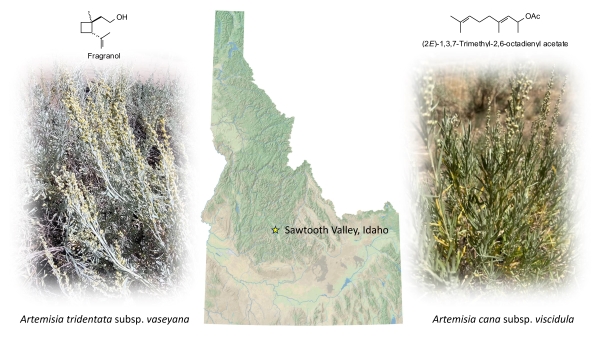
Sagebrush species, including Artemisia
tridentata, Artemisia ludoviciana, Artemisia frigida, and Artemisia
cana, are conspicuous features of the intermountain western region of North
America. As part of our interest in the volatile phytochemistry of aromatic and
medicinal plants, including sagebrush, of the western United States, we
obtained and analyzed the essential oils of Artemisia tridentata subsp. vaseyana
and Artemisia cana subsp. viscidula from the Sawtooth Valley of
central Idaho. Essential oils were obtained by hydrodistillation and analyzed
by gas chromatography – mass spectrometry. The essential oil of A.
tridentata subsp. vaseyana was dominated by fragranol (55.8-70.0%)
and fragranyl acetate (24.1-30.0%). The major components of A. cana
subsp. viscidula were (2E)-1,3,7-trimethyl-2,6-octadienyl acetate
(33.7-38.2%) and ethyl trans-chrysanthemumate (7.8-26.3%), along with
two major unidentified components (4.8-12.1% and 6.1-8.5%). The essential oil
compositions of these two sagebrush species are remarkably different from those
previously published and illustrate the complexity and variability of sagebrush
volatile components.
Keywords
Mountain big sagebrush, mountain silver
sagebrush, fragranol, fragranyl acetate, 1,3,7-trimethyl-2,6-octadienyl
acetate, ethyl trans-chrysanthemumate, chrysanthemal.
References
|
1. |
Johnston, K.M.
Evaluation of Linear Fuel Break Systems and Using Remote Sensing Data to
Estimate Live Fuel Moisture Content in South-Central Idaho, Ph.D.
Dissertation, University of Idaho, 2024. |
|
2. |
Doherty, K.;
Theobald, D.M.; Bradford, J.B.; Wiechman, L.A.; Bedrosian, G.; Boyd, C.S.;
Cahill, M.; Coates, P.S.; Creutzburg, M.K.; Crist, M.R.; et al. A Sagebrush
Conservation Design to Proactively Restore America’s Sagebrush Biome; U.S.
Geological Survey: Reston, Virginia, USA, 2022. |
|
3. |
World Flora Online,
W.F.O. An Online Flora of All Known Plants. Available online:
https://www.worldfloraonline.org/ (accessed on 26 May 2026). |
|
4. |
McArthur, E.D.;
Welch, B.L.; Sanderson, S.C. Natural and artificial hybridization between big
sagebrush (Artemisia tridentata) subspecies. J. Hered. 1988, 79,
268–276. https://doi.org/10.1093/oxfordjournals.jhered.a110508 |
|
5. |
Richardson, B.A.;
Page, J.T.; Bajgain, P.; Sanderson, S.C.; Udall, J.A. Deep sequencing of
amplicons reveals widespread intraspecific hybridization and multiple origins
of polyploidy in big sagebrush (Artemisia tridentata; Asteraceae). Am.
J. Bot. 2012, 99, 1962–1975. https://doi.org/10.3732/ajb.1200373 |
|
6. |
Shultz, L.M.
Monograph of Artemisia subgenus Tridentatae
(Asteraceae-Anthemideae). Syst. Bot. Monogr. 2009, 89, 1–131. |
|
7. |
Dunkel, F.V.; Sears,
L.J. Fumigant properties of physical preparations from mountain big
sagebrush, Artemisia tridentata Nutt. ssp. vaseyana (Rydb.)
Beetle for stored grain insects. J. Stored Prod. Res. 1998, 34, 307–321.
https://doi.org/10.1016/S0022-474X(98)00015-0 |
|
8. |
Gunawardena, K.;
Rivera, S.B.; Epstein, W.W. The monoterpenes of Artemisia tridentata
ssp. vaseyana, Artemisia cana ssp. viscidula and Artemisia
tridentata ssp. spiciformis. Phytochem. 2002, 59, 197–203.
https://doi.org/10.1016/S0031-9422(01)00438-1 |
|
9. |
Zheljazkov, V.D.;
Cantrell, C.L.; Jeliazkova, E.A.; Astatkie, T.; Schlegel, V. Essential oil
yield, composition, and bioactivity of sagebrush species in the Bighorn Mountains.
Plants. 2022, 11, 1228. https://doi.org/10.3390/plants11091228 |
|
10. |
Swor, K.; Satyal,
P.; Poudel, A.; Setzer, W.N. Chemical characterization of three Artemisia
tridentata essential oils and multivariate analyses: A preliminary
investigation. Nat. Prod. Commun. 2023, 18, 1934578X231154965. https://doi.org/10.1177/1934578X231154965 |
|
11. |
Howard, J.L. Artemisia
cana, Silver Sagebrush. Available online:
https://research.fs.usda.gov/feis/species-reviews/artcan (accessed on 24 May
2026). |
|
12. |
McArthur, E.D.;
Taylor, J.R. Artemisia cana Pursh, silver sagebrush. In Wildland
Shrubs of the United States and Its Territories: Thamnic Descriptions: Volume
1; Francis, J.K., Ed.; U.S. Department of Agriculture, Forest Service,
International Institute of Tropical Forestry: San Juan, Puerto Rico, pp.
57–59, 2004. |
|
13. |
Harvey, S.J. Life
History and Reproductive Strategies in Artemisia, M.S. Thesis, Montana
State University, 1981. |
|
14. |
Lopes-Lutz, D.;
Alviano, D.S.; Alviano, C.S.; Kolodziejczyk, P.P. Screening of chemical
composition, antimicrobial and antioxidant activities of Artemisia
essential oils. Phytochemistry 2008, 69, 1732–1738. https://doi.org/10.1016/j.phytochem.2008.02.014 |
|
15. |
Lopes-Lutz, D.;
Mckay, T.; Kolodziejczyk, P.P. Distribution of volatiles in Artemisia cana.
Pharm. Biol. 2008, 46, 373–376. https://doi.org/10.1080/13880200802055792 |
|
16. |
New York Botanical
Garden, N.Y.B.G. C. V. Starr Virtual Herbarium. Available online:
https://sweetgum.nybg.org/science/vh/ (accessed on 6 March 2026). |
|
17. |
van den Dool, H.;
Kratz, P.D. A generalization of the retention index system including linear
temperature programmed gas-liquid partition chromatography. J. Chromatogr. A
1963, 11, 463–471. https://doi.org/10.1016/S0021-9673(01)80947-X |
|
18. |
Adams, R.P.
Identification of Essential Oil Components by Gas Chromatography/Mass
Spectrometry, 4th ed.; Allured Publishing: Carol Stream, Illinois, USA, 2007;
ISBN 978-1-932633-21-4. |
|
19. |
Satyal, P.
Development of GC-MS Database of Essential Oil Components by the Analysis of
Natural Essential Oils and Synthetic Compounds and Discovery of Biologically
Active Novel Chemotypes in Essential Oils, Ph.D. Dissertation, University of
Alabama in Huntsville, Huntsville, AL, USA, 2015. |
|
20. |
Mondello, L. FFNSC
3; Shimadzu Scientific Instruments: Columbia, Maryland, USA, 2016. |
|
21. |
NIST20; National
Institute of Standards and Technology: Gaithersburg, Maryland, USA, 2020. |
|
22. |
W23N23; Wiley
Registry/NIST Mass Spectral Library; John Wiley & Sons, Inc: Hoboken, New
Jersey, USA, 2023. |
|
23. |
Chen, F.; Zu, Y.;
Yang, L. A novel approach for isolation of essential oil from fresh leaves of
Magnolia sieboldii using microwave-assisted simultaneous distillation
and extraction. Sep. Purif. Technol. 2015, 154, 271–280. https://doi.org/10.1016/j.seppur.2015.09.066 |
|
24. |
Jesionek, A.;
Zabiegała, B.; Buciński, A.; Łuczkiewicz, M. From harvesting to distillation
‒ effect of analytical procedures on the yield and chemical composition of Rhododendron
tomentosum (Ledum palustre) essential oil. Acta Pol. Pharm. - Drug
Res. 2019, 76, 83–92. https://doi.org/10.32383/appdr/93932 |
|
25. |
Kokotkiewicz, A.;
Badura, A.; Tabaczyńska, Ż.; Lorenc, A.; Buciński, A.; Luczkiewicz, M.
Optimization of distillation conditions for improved recovery of phthalides
from celery (Apium graveolens L.) seeds. Polish J. Food Nutr. Sci.
2021, 71, 197–210. https://doi.org/10.31883/pjfns/137612 |
|
26. |
Hasanvandi, S.;
Neisi, E.; Meshkat, M.H. Comparative analysis of essential oils from two Satureja
species; extraction methods, chemical composition, and antimicrobial
activities. Biocatal. Agric. Biotechnol. 2023, 50, 102731. https://doi.org/10.1016/j.bcab.2023.102731 |
|
27. |
Faria, J.M.S.;
Figueiredo, A.C.; Teixeira, D.M.; Inácio, M.L. Infection of in vivo and in
vitro pines with the pinewood nematode Bursaphelenchus xylophilus and
isolation of induced volatiles. J. Vis. Exp. 2024, 211, e67149.
https://doi.org/10.3791/67149 |
|
28. |
Au-Yeung, C.Y.;
MacLeod, A.J. A comparison of the efficiency of the Likens and Nickerson
extractor for aqueous, lipid/aqueous, and lipid samples. J. Agric. Food Chem.
1981, 29, 502–505. https://doi.org/10.1021/jf00105a016 |
|
29. |
Eikani, M.H.;
Golmohammad, F.; Rowshanzamir, S.; Mirza, M. Recovery of water-soluble
constituents of rose oil using simultaneous distillation-extraction. Flavour
Fragr. J. 2005, 20, 555–558. https://doi.org/10.1002/ffj.1482 |
|
30. |
Swor, K.; Satyal,
P.; Timsina, S.; Setzer, W.N. Chemical composition and terpenoid enantiomeric
distribution of the essential oil of Artemisia tridentata subsp. tridentata
from southwestern Idaho. Nat. Prod. Commun. 2022, 17, 1934578X2211174.
https://doi.org/10.1177/1934578x221117417 |
|
31. |
Swor, K.; Poudel,
A.; Satyal, P.; Setzer, W.N. The essential oil compositions of Ambrosia
acanthicarpa Hook., Artemisia ludoviciana Nutt., and Gutierrezia
sarothrae (Pursh) Britton & Rusby (Asteraceae) from the Owyhee
Mountains of Idaho. Molecules. 2024, 29, 1383. https://doi.org/10.3390/molecules29061383 |
|
32. |
Baldemir, A.;
Karaman, Ü.; İlgün, S.; Kaçmaz, G.; Demirci, B. Antiparasitic efficacy of Artemisia
ludoviciana Nutt. (Asteraceae) essential oil for Acanthamoeba
castellanii, Leishmania infantum and Trichomonas vaginalis.
Indian J. Pharm. Educ. Res. 2018, 52, 416–425. https://doi.org/10.5530/ijper.52.3.48 |
|
33. |
Anaya-Eugenio, G.D.;
Rivero-Cruz, I.; Bye, R.; Linares, E.; Mata, R. Antinociceptive activity of
the essential oil from Artemisia ludoviciana. J. Ethnopharmacol. 2016,
179, 403–411. https://doi.org/10.1016/j.jep.2016.01.008 |
|
34. |
Collin, G.;
St-Gelais, A.; Turcotte, M.; Gagnon, H. Composition of the essential oil and
of some extracts of the aerial parts of Artemisia ludoviciana var. latiloba
Nutt. Am. J. Essent. Oils Nat. Prod. 2017, 5, 1–11. |
|
35. |
Setzer, W.N.;
Satyal, P.; Poudel, A. Chemical composition of Artemisia frigida
Willd. from southwestern Idaho. Am. J. Essent. Oils Nat. Prod. 2025, 13,
38–44. |
|
36. |
Dylenova, E.P.;
Zhigzhitzhapova, S. V.; Gulyaev, S.M.; Taraskin, V. V.; Randalova, T.E.;
Radnaeva, L.D. Artemisia frigida Willd. of the Baikal Region
(Siberia): Essential oils, tincture, and antiradical activity. J. Herb. Med.
2023, 42, 100781. https://doi.org/10.1016/j.hermed.2023.100781 |
|
37. |
Korolyuk, E.A.;
Tkachev, A.V. Chemical composition of the essential oil from two wormwood
species Artemisia frigida and Artemisia argyrophylla. Russ. J.
Bioorganic Chem. 2010, 36, 884–893. https://doi.org/10.1134/S1068162010070162 |
|
38. |
Liu, X.C.; Li, Y.;
Wang, T.; Wang, Q.; Liu, Z.L. Chemical composition and insecticidal
activities of essential oil of Artemisia frigida Willd (Compositae)
against two grain storage insects. Trop. J. Pharm. Res. 2014, 13, 587–592.
https://doi.org/10.4314/tjpr.v13i4.15 |
|
39. |
Zhang, Z.; Pang, X.;
Guo, S.; Cao, J.; Wang, Y.; Chen, Z.; Feng, Y.; Lei, N.; Du, S. Insecticidal
activity of Artemisia frigida Willd. essential oil and its
constituents against three stored product insects. Rec. Nat. Prod. 2019, 13,
176–181. https://doi.org/10.25135/rnp.91.18.06.114 |
|
40. |
Zhigzhitzhapova, S.V.;
Randalova, T.E.; Radnaeva, L.D.; Dylenova, E.P.; Chen, S.; Zhang, F. Chemical
composition of essentials oils of Artemisia frigida Willd.
(Asteraceae) grown in the North and Central Asia. J. Essent. Oil-Bearing
Plants 2017, 20, 915–926. https://doi.org/10.1080/0972060X.2017.1377113 |
|
41. |
Bohlmann, F.; Zdero,
C.; Faass, U. Natürlich Vorkommende Terpenderivate, XXVI. Über Die
Inhaltsstoffe von Artemisia fragrans Willd. Chem. Ber. 1973, 106,
2904–2909. https://doi.org/10.1002/cber.19731060919 |
|
42. |
Demirci, F.;
Demirci, B.; Gürbüz, I.; Yeşilada, E.; Başer, K.H.C. Characterization and
biological activity of Achillea teretifolia Willd. and A. nobilis
L. subsp. neilreichii (Kerner) Formanek essential oils. Turkish J.
Biol. 2009, 33, 129–136. https://doi.org/10.3906/biy-0808-1 |
|
43. |
Čulum, D.;
Čopra-Janićijević, A.; Muratović, E.; Siljak-Yakovlev, S.; Maksimović, M.;
Vidic, D. Essential oil composition and antioxidant activity of endemic Achillea
lingulata Waldst. & Kit. compared to common A. millefolium L.
Rec. Nat. Prod. 2022, 16, 335–345. http://doi.org/10.25135/rnp.285.2107.2143 |
|
44. |
Ghavam, M.;
Castangia, I.; Manconi, M.; Bacchetta, G.; Manca, M.L. Chemical composition
and antimicrobial activity of a newly identified chemotype of Achillea
wilhelmsii K.Koch from Kashan, Iran. Sci. Rep. 2024, 14, 22655.
https://doi.org/10.1038/s41598-024-73284-0 |
|
45. |
Hulley, I.M.;
Sadgrove, N.J.; Tilney, P.M.; Özek, G.; Yur, S.; Özek, T.; Başer, K.H.C.; van
Wyk, B.E. Essential oil composition of Pentzia incana (Asteraceae), an
important natural pasture plant in the Karoo Region of South Africa. African
J. Range Forage Sci. 2018, 35, 137–145. https://doi.org/10.2989/10220119.2018.1495265 |
|
46. |
Radulović, M.;
Rajčević, N.; Gavrilović, M.; Novaković, J.; Stešević, D.; Marin, P.D.;
Janaćković, P. Five wild-growing Artemisia (Asteraceae) species from
Serbia and Montenegro: Essential oil composition and its chemophenetic
significance. J. Serbian Chem. Soc. 2021, 86, 1281–1290. https://doi.org/10.2298/JSC210803088R |
|
47. |
Schepetkin, I.A.;
Özek, G.; Özek, T.; Kirpotina, L.N.; Khlebnikov, A.I.; Klein, R.A.; Quinn,
M.T. Neutrophil immunomodulatory activity of farnesene, a component of Artemisia
dracunculus essential oils. Pharmaceuticals. 2022, 15, 642. https://doi.org/10.3390/ph15050642 |
|
48. |
Sugawara, Y.;
Uesato, T.; Tabata, J. Sex pheromone of the papaya mealybug. J. Chem. Ecol.
2025, 51, 22. https://doi.org/10.1007/s10886-025-01574-6 |
|
49. |
Tumlinson, J.H.;
Hardee, D.D.; Gueldner, R.C.; Thompson, A.C.; Hedin, P.A.; Minyard, J.P. Sex
pheromones produced by male boll weevil: Isolation, identification, and
synthesis. Science 1969, 166, 1010–1012. https://doi.org/10.1126/science.166.3908.1010 |
|
50. |
Phillips, T.W.;
West, J.R.; Foltz, J.L.; Silverstein, R.M.; Lanier, G.N. Aggregation
pheromone of the deodar weevll, Pissodes nemorensis (Coleoptera:
Curculionidae): Isolation and activity of grandisol and grandisal. J. Chem.
Ecol. 1984, 10, 1417–1423. https://doi.org/10.1007/BF00990312 |
|
51. |
Malaspina, P.;
Polito, F.; Mainetti, A.; De Feo, V.; Cornara, L. Anatomical,
micromorphological and phytochemical characterization of Artemisia
chamaemelifolia, a rare plant in the western Italian Alps. Plant Biosyst.
2025, 159, 1050–1061. https://doi.org/10.1080/11263504.2025.2522717 |
|
52. |
Curado, M.A.;
Oliveira, C.B.A.; Jesus, J.G.; Santos, S.C.; Seraphin, J.C.; Ferri, P.H.
Environmental factors influence on chemical polymorphism of the essential
oils of Lychnophora ericoides. Phytochem. 2006, 67, 2363–2369.
https://doi.org/10.1016/j.phytochem.2006.08.002 |
|
53. |
Rabelo, R.S.; Dyer,
L.A.; Yamaguchi, L.F.; Diniz, I.; Simbaña, W.; Kussano, A.J.M.; Kato, M.J.;
Massad, T.J. Plasticity in plant defense and the role of phytochemical
dissimilarity in limiting specialist herbivory. Front. Ecol. Evol. 2023, 11,
1175590. https://doi.org/10.3389/fevo.2023.1175590 |
|
54. |
Pu, X.; Lam, L.; Gehlken,
K.; Ulappa, A.C.; Rachlow, J.L.; Forbey, J.S. Antioxidant capacity of Wyoming
big sagebrush (Artemisia tridentata ssp. wyomingensis) varies
spatially and is not related to the presence of a sagebrush dietary
specialist. West. North Am. Nat. 2015, 75, 78–87. https://doi.org/10.3398/064.075.0109 |
|
55. |
da Fonseca, S.T.D.;
Pereira, A.M.S.; Lopes, N.P. Secondary metabolite plasticity in Eclipta
prostrata (L.) L. (Asteraceae) under environmental and biological
stressors. ACS Omega. 2025, 10, 62916–62926. https://doi.org/10.1021/acsomega.5c08697 |
|
56. |
Qu, K.; Cheng, Y.;
Gao, K.; Ren, W.; Fry, E.L.; Yin, J.; Liu, Y. Growth-defense trade-offs
induced by long-term overgrazing could act as a stress memory. Front. Plant
Sci. 2022, 13, 917354. https://doi.org/10.3389/fpls.2022.917354 |
|
57. |
13. Siqueira, C.S.; Dos Santos, V.S.; Carollo,
C.A.; Damasceno-Junior, G.A. Unraveling the adaptive chemical traits of Rhamnidium
elaeocarpum Reissek in response to fire in Pantanal wetlands. Sci. Rep.
2023, 13, 11860. https://doi.org/10.1038/s41598-023-38725-2 |
|
58. |
Poudel, A.; Satyal,
P.; Swor, K.; Setzer, W.N. The essential oil characterization of Achillea
millefolium var. occidentalis DC . from the Great Basin of North
America. J. Essent. Oil Plant Compos. 2024, 2, 130–142. https://doi.org/10.58985/jeopc.2024.v02i02.53 |
|
59. |
Mcarthur, E.D.; Mudge, J.; Van Buren, R.; Andersen, W.R.; Sanderson,
S.C.; Babbel, D.G. Randomly amplified polymorphic DNA analysis (RAPD) of Artemisia
subgenus Tridentatae species and hybrids. Gt. Basin Nat. 1998, 58,
12–27. |

This work is licensed under the
Creative Commons Attribution
4.0
License (CC BY-NC 4.0).
Abstract
Sagebrush species, including Artemisia
tridentata, Artemisia ludoviciana, Artemisia frigida, and Artemisia
cana, are conspicuous features of the intermountain western region of North
America. As part of our interest in the volatile phytochemistry of aromatic and
medicinal plants, including sagebrush, of the western United States, we
obtained and analyzed the essential oils of Artemisia tridentata subsp. vaseyana
and Artemisia cana subsp. viscidula from the Sawtooth Valley of
central Idaho. Essential oils were obtained by hydrodistillation and analyzed
by gas chromatography – mass spectrometry. The essential oil of A.
tridentata subsp. vaseyana was dominated by fragranol (55.8-70.0%)
and fragranyl acetate (24.1-30.0%). The major components of A. cana
subsp. viscidula were (2E)-1,3,7-trimethyl-2,6-octadienyl acetate
(33.7-38.2%) and ethyl trans-chrysanthemumate (7.8-26.3%), along with
two major unidentified components (4.8-12.1% and 6.1-8.5%). The essential oil
compositions of these two sagebrush species are remarkably different from those
previously published and illustrate the complexity and variability of sagebrush
volatile components.
Abstract Keywords
Mountain big sagebrush, mountain silver
sagebrush, fragranol, fragranyl acetate, 1,3,7-trimethyl-2,6-octadienyl
acetate, ethyl trans-chrysanthemumate, chrysanthemal.
This work is licensed under the
Creative Commons Attribution
4.0
License (CC BY-NC 4.0).
Editor-in-Chief


This work is licensed under the
Creative Commons Attribution 4.0
License.(CC BY-NC 4.0).