
Research Article
Received: 2026-06-01 | Revised:2026-06-22 | Accepted: 2026-06-29 | Published: 2026-07-08
Pages: 165-177
DOI: https://doi.org/10.58985/jafsb.2026.v04i02.101
Abstract
The rising cost of conventional granular fertilizers
has become a major constraint in tobacco production, limiting fertilizer
accessibility and reducing profitability for smallholder farmers. Nano-fertilizers
offer a potential option for reducing dependence on conventional fertilizers
while maintaining the crop performance. This pilot study assessed the potential
of ROKO nano DAP and ROKO nano-urea to supplement reduced rates of conventional
NPK fertilizer in tobacco production. Field experiments were conducted using 36
m² research plots and 2,400 m² demonstration plots under treatments comprising ROKO
Nano DAP, ROKO nano-urea, reduced NPK rates, the recommended NPK rate, and an
unfertilized control. The data collected included leaf area, green leaf yield,
and dry leaf yield. Integrating reduced basal NPK fertilizer (15 g plant⁻¹)
with ROKO nano DAP and ROKO nano-urea significantly improved leaf growth and
yield compared to the unfertilized control and nano fertilizers applied alone.
In the 36 m² plots, the treatment combining ROKO nano DAP drench, reduced NPK
fertilizer, and ROKO nano urea foliar application (T1) produced the highest
leaf area (458.21 cm²), green leaf yield (6,808.60 kg ha⁻¹), and dry leaf yield
(1,361.72 kg ha⁻¹), which were comparable to those of the standard fertilizer
treatment. In the 2,400 m² plots, the treatment combining reduced NPK
fertilizer with ROKO nano DAP and ROKO nano-urea applications (T4) achieved
green and dry leaf yields of 9,764.23 and 1,855.20 kg ha⁻¹, respectively, which
were statistically similar to the standard fertilizer treatment. This pilot
study demonstrated that ROKO nano DAP and ROKO nano-urea can complement the reduced
rates of conventional NPK fertilizer without significant yield penalties in
tobacco production. However, further research needs to be conducted in the
three tobacco ecological zones to conclude the research while considering the determination
of leaf reducing sugars, grade index, and nicotine, but also to assess the soil
fertility status before and after the trials for determining the contributing
factors to tobacco growth, yield and quality in response to basal granular and
nano foliar fertilizers to provide conclusive results regarding the effectiveness
of these fertilizer types.
Keywords
Nano fertilizer, tobacco, ROKO nano DAP, ROKO nano-urea,
foliar application.
1. Introduction
Nitrogen
(N) is one of the most essential nutrients for crop growth and productivity,
playing a critical role in photosynthesis, protein synthesis, chlorophyll
formation, and overall plant metabolism [1-4].
However, low nitrogen use efficiency (NUE) remains a major challenge in modern
agriculture, with a substantial proportion of applied nitrogen fertilizers lost
through volatilization, leaching, denitrification, and runoff [5-7]. Conventional nitrogen fertilizers,
particularly urea and NPK (nitrogen, phosphorous and potassium), have been
extensively used worldwide to sustain crop production and meet increasing food
and industrial crop demands [8-13]. Despite
their effectiveness, excessive reliance on conventional fertilizers has
resulted in several environmental and economic concerns, including nitrate
contamination of groundwater, greenhouse gas emissions, soil degradation, and
increased production costs [14-19].
Furthermore, the global fertilizer market has recently experienced severe
instability due to geopolitical conflicts, such as the Russia - Ukraine war and
tensions involving the United States and Iran, which have disrupted fertilizer
supply chains and increased fertilizer prices globally [20-23].
These challenges necessitate the development of alternative nutrient management
strategies that enhance fertilizer efficiency while reducing production costs
and environmental impact.
Nanotechnology
has recently emerged as a promising approach for improving nutrient management
in agriculture. Nanomaterials are generally defined as materials possessing at
least one dimension between 1 and 100 nm. Their unique physicochemical
properties, including high surface area, enhanced reactivity, and controlled
release characteristics, have enabled their application in crop nutrition
through the development of nano-fertilizers [24-27].
Nano fertilizers are considered “smart fertilizers” because they facilitate
targeted and gradual nutrient release, thereby improving nutrient uptake
efficiency and minimizing nutrient losses. Unlike conventional fertilizers, which
often leach into the environment and cause degradation, nano-fertilizers have
been reported to improve soil physicochemical properties, enhance nutrient
availability, reduce toxicity to soil microorganisms, and mitigate
environmental pollution associated with excessive fertilizer application [28-31].
Nano-urea
and nano DAP represent promising nutrient management innovations with the
potential to enhance nitrogen and phosphorus use efficiency nano-urea [32-33]. Nano-urea is a liquid fertilizer
containing nanoscale nitrogen particles designed to provide nitrogen directly
through foliar absorption. A 500 mL bottle of nano-urea
containing 40,000 mgL⁻¹ nitrogen can partially substitute conventional urea
while achieving higher nutrient use efficiency [34].
Conventional urea generally exhibits only 30 - 40% nitrogen recovery
efficiency, whereas nano-urea has demonstrated efficiency levels
exceeding 80% due to reduced nutrient losses and improved foliar absorption [28]. Field evaluations conducted on more than
11,000 farmers’ fields across different crops, including rice and wheat,
reported average yield increases of approximately 8% following nano-urea application
[16, 35, 36].
Several
studies have shown that, the agronomic and environmental benefits of nano-fertilizers
[31, 37-40]. Alimohammadi et al. [40] reported that nano nitrogen fertilizers
significantly reduced nitrate leaching while improving sugar production in
sugarcane. Similarly, Hoque and Khan [41] observed
that combining 50% conventional urea with three foliar sprays of nano-urea produced superior potato growth,
chlorophyll content, starch accumulation, and tuber yield compared with
conventional fertilization practices. Their findings further indicated that nano-urea
reduced chemical fertilizer use by 50% while maintaining crop productivity. In
another study, Kumar et al. [16] demonstrated
that the application of 75% recommended nitrogen through prilled urea
supplemented with nano-urea and nano-zinc sprays produced yields comparable to
the full recommended nitrogen dose in cereal crops. Upadhyay et al. [5] further concluded that integrating nano-urea
with reduced conventional nitrogen fertilization represents an economically
viable and environmentally sustainable nutrient management strategy.
At
the physiological and molecular levels, nano-fertilizers have also shown
positive effects on plant growth and stress tolerance [42-44].
Jangir et al. [45] reported that plants
treated with nano-urea exhibited increased expression of genes associated with
nitrogen assimilation, photosynthesis, growth, and stress tolerance compared
with conventional urea-treated plants. The foliar application of nano-fertilizers
has also been shown to improve seedling vigor and vegetative growth in tobacco [46]. Moreover, the sequential application of nano
DAP and nano-urea enhanced crop growth and quality
traits compared with conventional fertilizer programs [47].
These findings collectively suggest that nano-fertilizers can improve nutrient-use
efficiency, maintain crop productivity under reduced fertilizer inputs, and
contribute to environmentally sustainable agricultural systems.
Flue-cured
tobacco (Nicotiana tabacum L.) is a high-value commercial crop that
requires substantial nutrient inputs, particularly nitrogen and potassium, to
achieve optimal leaf yield and quality [48].
In many Tanzanian tobacco-growing regions, conventional fertilization programs
rely heavily on the basal application of NPK (10:18:24) compound fertilizers ten
bags per hectare, followed by topdressing with two and a half bags of calcium
ammonium nitrate (CAN) [49]. Although these
fertilization regimes support satisfactory crop performance and quality, they
contribute significantly to production costs, especially under conditions of
escalating fertilizer prices and unstable global fertilizer supply. Therefore,
improving nutrient-use efficiency through innovative fertilizer technologies
may provide opportunities to reduce fertilizer inputs without compromising
tobacco productivity and quality.
Despite the increasing body of evidence supporting the effectiveness of nano-fertilizers in various crops, limited information is available regarding the combined use of ROKO nano DAP and ROKO nano-urea in flue-cured tobacco production systems as new products in Tanzania. In particular, little is known about their potential to partially substitute conventional basal and top-dressing fertilizers under field conditions while maintaining the same agronomic performance. Therefore, this pilot study aimed to evaluate the effects of ROKO nano DAP and ROKO nano-urea foliar application combined with reduced rates of conventional NPK (10:18:24) fertilizer on the growth, yield, and quality of flue-cured tobacco. We also aimed to assess whether nano-fertilizers can reduce fertilizer input requirements and production costs for tobacco growers while maintaining crop performance under current global fertilizer supply challenges.
2. Materials and methods
2.1. Study area and experimental materials
The
current standard fertilization practice in Tanzania consist of the basal
application of NPK (10:18:24) at 30 g plant⁻¹ 7 days after transplanting (DAT),
followed by top-dressing with CAN (27% N) at 8 g plant⁻¹ at 21 DAT. The current
standard fertilization practice was compared with a reduced conventional standard
fertilizer treatment comprising NPK (10:18:24) at 15 g plant⁻¹ supplemented
with foliar ROKO Nano DAP and ROKO nano-urea
applications. This study was conducted to assess whether ROKO nano foliar fertilizers
can reduce fertilizer input requirements and production costs for tobacco
growers while maintaining crop performance under current global fertilizer
supply challenges. Field experiments were conducted during the 2025-26 cropping
season at Tumbi, a site in Tabora Region, Tanzania, located 1151 m above of the
sea level (m.a.s.l.). The site experiences average annual temperature of 27°C
and an average annual rainfall of approximately 950 mm. A flue-cured tobacco
variety, Nicotiana tabacum L. cv. K326, sourced from the Tobacco
Research Institute of Tanzania (TORITA), was used in these experiments. Seeds
were sown in seedbeds at Tumbi-Tabora. A seedbed measuring 1.5 m × 20 m was
established, applied with 5 kg of N10P18K24
fertilizer. The N10P18K24 fertilizer contained
10% N, 18% P2O5, 24% K2O, 0.5% MgO, 3% CaO, 7%
S and 0.012% B. Seedlings were hardened for two weeks before transplanting to
the field. Mature seedlings were transplanted 60 days after sowing at a spacing
of 1.2 m between ridges and 0.50 m between plants.
2.2. Field trial and experimental design
The
experiments were conducted using a Randomized Complete Block Design (RCBD)
consisting of five fertilizer treatments replicated three times at each site
location. Two independent field trials were established: a small plot trial (6
m × 6 m) in loamy sand soil and a large-scale plot trial (100 m x 24 m) in loamy
sand soil consisting of 1000 plants per plot. The standard N10P18K24
fertilizer as similar to that used in the seedbed, was also used for the field
trial and had additional of 0.5% MgO, 3% CaO, 7% S and 0.012% B. The ROKO nano
DAP contained 8% N and 16% P and ROKO nano-urea
contained 46% N.
2.2.1. First field trial of 6 m by 6 m plot
Treatment descriptions
Treatment 1 (T1): ROKO nano DAP was applied as a drench at a rate of 30 mL per
plant prepared by mixing 4 mL of ROKO nano DAP in 1 L of water and applied at 3
days after treatment (DAT). At 7 DAT, a
reduced rate of NPK (10:18:24) fertilizer was applied at 15 g/plant. Foliar ROKO
nano-urea applications were carried out at 21, 35, and 49 DAT.
Treatment 2 (T2): Treatment similar to T1, except that no NPK fertilizer was
applied. ROKO nano DAP was instead applied as a foliar spray at 7 DAT followed
by foliar ROKO nano-urea applications at 21, 35, and 49 DAT.
Treatment 3 (T3): NPK (10:18:24) fertilizer was applied at 15 g per plant at 7
DAT, followed by foliar ROKO nano-urea application at 21, 35, and 49 DAT.
Treatment 4 (T4):
Unfertilized
control.
Treatment 5 (T5): Standard fertilizer treatment
consisting of 30 g NPK (10:18:24) per plant applied basally at 7 DAT, followed
by 8 g CAN (27% N) per plant applied as topdressing at 21 DAT.
2.2.2 Second field trial of 100 m x 24 m plot
Treatments descriptions
Treatment 1 (T1): ROKO nano DAP drench was applied at 30 mL per plant at 3
DAT. Foliar ROKO nano DAP was applied at 14 DAT, followed by foliar ROKO nano-urea
applications at 28 and 35 DAT. Nano- fertilizers were prepared by mixing 64 mL
of nano-fertilizer in 16 L of water.
Treatment 2 (T2): NPK (10:18:24) fertilizer was applied at 15 g per plant at 7
DAT followed by foliar ROKO nano DAP application at 14 DAT and foliar ROKO nano-urea
applications at 35 and 49 DAT.
Treatment 3 (T3): Standard fertilizer treatment consisting of 30 g NPK
(10:18:24) per plant applied at 7 DAT, followed by 8 g CAN (27% N) per plant at
21 DAT.
Treatment 4 (T4): NPK (10:18:24) fertilizer was applied at 15 g per plant at 7
DAT, followed by foliar ROKO nano DAP at 21 DAT and foliar ROKO nano-urea at 42
DAT.
Treatment 5 (T5): Unfertilized control.
2.3. Determination of leaf length, width, and area
A mature middle leaf was sampled from plants located within the three inner rows of each plot, resulting in nine sampled plants per plot. Leaf length and width were measured using a measuring tape.
The leaf area was determined using the following equation:
Leaf Area = Leaf Length × Leaf Width × 0.64 (1)
Where,
0.64 represents the correction coefficient factor for tobacco leaves.
2.4. Leaf harvesting
Leaves
were harvested weekly according to the ripening stage. Weights of the fresh
green leaves were measured using a digital balance immediately after
harvesting. The harvested leaves were then cured in curing barns for seven
days. After curing, the dry leaf weight was recorded using a digital weighing
scale.
2.5. Statistical analysis
Data collected on leaf length, width, area, green leaf weight, and cured leaf weight were subjected to statistical analysis using the Statistica software package version 8.0. Analysis of variance (ANOVA) was performed under the Randomized Complete Block Design (RCBD) model to determine treatment effects. Fertilizer treatments were considered as the main experimental factor. Mean separation was conducted using Fisher’s significant difference test at a significance level at p ≤ 0.05. Highly significant differences were considered at p ≤ 0.001.
3. Results
3.1. Impact of nano-fertilizer on tobacco leaf yields in the first field 6 m x 6 m plot
The effects of fertilizer treatments on leaf length, leaf width, and leaf area in the 36 m² plots (sandy soil) are presented in Table 1. The unfertilized treatment (T4) and treatment T2, which received ROKO nano DAP foliar application at 7 DAT followed by ROKO nano-urea foliar applications at 21, 35, and 49 DAT, recorded the lowest values for leaf length, width, and area.
The standard treatment (T5), which received NPK fertilizer at 30 g plant⁻¹ at 7 DAT followed by CAN (27% N) at 8 g/plant at 21 DAT, significantly improved leaf length (34.74 ± 1.29 cm), leaf width (13.49 ± 0.49 cm), and leaf area (298.37 ± 22.07 cm²). However, these values were significantly lower than those obtained in treatment T3, where plants received NPK at 15 g plant⁻¹ at 7 DAT followed by ROKO nano-urea foliar applications at 21, 35, and 49 DAT, resulting in leaf length, width, and area of 39.98 ± 2.64 cm, 16.32 ± 1.16 cm, and 417.94 ± 57.73 cm², respectively.
Treatment T3 did not differ significantly from treatment T1, which received 30 mL ROKO nano DAP through drenching at 3 DAT, followed by NPK at 15 g/plant at 7 DAT and ROKO nano-urea foliar applications at 21, 35, and 49 DAT. Treatment T1 produced the highest leaf length (42.41 ± 2.02 cm), leaf width (16.95 ± 0.81 cm), and leaf area (458.21 ± 42.65 cm²).
Table 1. Impact of ROKO nano DAP and ROKO nano-urea application on tobacco leaf length, width and area in a 6 m x 6 m plot.
Treatments | Leaf length (cm) | Leaf width (cm) | Leaf area (cm2) |
T1 3DAT 30 mls drench ROKO nano DAP, 7DAT NPK 15g, 21,35 & 49 DAT ROKO nano-urea foliar | 42.41 ± 2.02 a | 16.95 ± 0.81 a | 458.21 ± 42.65 a |
T2 7DAT ROKO nano DAP foliar, 21, 35 & 49 DAT ROKO nano-urea foliar | 32.07 ± 3.62 c | 12.53 ± 1.42 c | 261.51 ± 55.29 c |
T3 7DAT NPK 15g/plant, 21, 35 & 49 DAT ROKO nano-urea foliar | 39.98 ± 2.64 ab | 16.32 ± 1.16 ab | 417.94 ± 57.73 ab |
T4 No fertilizer | 31.71 ± 1.37 c | 12.57 ± 0.80 c | 245.33 ± 27.78 c |
T5 standard 7DAT NPK 30g/plant, 21 DAT CAN 27% N 8g/plant | 34.74 ± 1.29 bc | 13.49 ± 0.49 bc | 298.37 ± 22.07 bc |
One-WAY ANOVA F-statistics | | | |
Treatment (T) | 4.14* | 4.52* | 5.23** |
The effects of the fertilizer treatments on green and dry leaf yields in the 36 m² plots are presented in Table 2. The unfertilized treatment (T4) produced the lowest green leaf yield (2250.14 ± 189.54 kg ha⁻¹) and dry leaf yield (510.02 ± 37.90 kg ha⁻¹). These values did not differ significantly from those of treatment T2, which received ROKO nano DAP foliar application at 7 DAT followed by ROKO nano-urea foliar applications at 21, 35, and 49 DAT, producing green and dry leaf yields of 3803.43 ± 729.38 kg ha⁻¹ and 760.68 ± 145.87 kg ha⁻¹, respectively.
Table 2. Impact of ROKO nano DAP and ROKO nano-urea application on tobacco green leaf and dry leaf yield in a 6 m x 6 m plot.
Treatments | Green leaf (kg/ha) | Dry leaf (kg/ha) |
T1 3DAT 30 mls drench ROKO nano DAP, 7DAT NPK 15g, 21,35 & 49 DAT ROKO nano-urea foliar | 6808.60 ± 980.97 a | 1361.72 ± 196.19 a |
T2 7DAT ROKO nano DAP foliar, 21, 35 & 49 DAT ROKO nano-urea foliar | 3803.43 ± 729.38 b | 760.68 ± 145.87 b |
T3 7DAT NPK 15g/plant, 21, 35 & 49 DAT ROKO nano-urea foliar | 6684.34 ± 493.52 a | 1336.87 ± 98.70 a |
T4 No fertilizer | 2550.14 ± 189.54 b | 510.02 ± 37.90 b |
T5 standard 7DAT NPK 30g/plant, 21 DAT CAN 27% N 8g/plant | 6843.21 ± 1060.45 a | 1368.64 ± 292.09 a |
One-WAY ANOVA F-statistics | | |
Treatment (T) | 4.14* | 4.52* |
Significantly higher green and dry leaf yields were recorded in the treatments of T5, T3, and T1. The standard treatment (T5), consisting of NPK at 30 g plant⁻¹ applied at 7 DAT followed by CAN (27% N) at 8 g/plant at 21 DAT, produced green and dry leaf yields of 6843.21 ± 1060.45 kg ha⁻¹ and 1368.64 ± 292.09 kg ha⁻¹, respectively. Similarly, treatment T3, which received NPK at 15 g/plant at 7 DAT, followed by ROKO nano-urea foliar applications at 21, 35, and 49 DAT, produced green and dry leaf yields of 6684.34 ± 493.52 kg ha⁻¹ and 1336.87 ± 98.70 kg ha⁻¹, respectively. Treatment T1, which involved 30 mL ROKO nano DAP drenching at 3 DAT, followed by NPK at 15 g/plant at 7 DAT and ROKO nano-urea foliar applications at 21, 35, and 49 DAT, produced green and dry leaf yields of 6808.60 ± 980.97 kg ha⁻¹ and 1361.72 ± 196.19 kg ha⁻¹, respectively.
3.2. Impact of nano-fertilizer on tobacco leaf yields in the second field 100 m x 24 m plot
The results for leaf length, width, and area in the 2,400 m2 plots are presented in Table 3. No significant differences were observed among the treatments T1, T2, and unfertilized control (T5). Treatment T1 received ROKO nano-DAP through drenching at 3 DAT, followed by ROKO nano DAP foliar application at 14 DAT and ROKO nano-urea foliar applications at 35 and 42 DAT, respectively. Treatment T2 received reduced NPK fertilizer at 15 g plant⁻¹ at 7 DAT, followed by ROKO nano DAP foliar application at 14 DAT and ROKO nano-urea foliar applications at 35 and 49 DAT.
Table 3. Impact of ROKO nano DAP and ROKO nano-urea application on tobacco leaf length, width and area in 100 m x 24 m plot.
Treatments | Leaf length (cm) | Leaf width (cm) | Leaf area (cm2) |
T1 3DAT 30 mls drench ROKO nano DAP, 14DAT ROKO nano DAP foliar, 35 & 42DAT ROKO nano-urea foliar | 37.48 ± 1.14 c | 14.41 ± 0.51 cd | 343.63 ± 22.85 c |
T2 7DAT NPK 15g/plant, 14DAT ROKO nano DAP foliar, 35 & 49 DAT ROKO nano-urea foliar | 37.64 ± 1.25 c | 15.01 ± 0.43 c | 359.35 ± 22.38 c |
T3 standard 7DAT NPK 30g/plant, 21 DAT CAN 27% N 8g/plant | 55.61 ± 1.74 a | 26.23 ± 0.82 a | 927.65 ± 58.30 a |
T4 7DAT NPK 15g/plant, 21 DAT ROKO Nano DAP foliar, 42 DAT ROKO nano-urea foliar | 49.66 ± 1.66 b | 22.40 ± 0.78 b | 707.63 ± 48.38 b |
T5 unfertilized | 33.71 ± 0.85 c | 12.57 ± 0.34 d | 269.47 ± 14.34 c |
One-WAY ANOVA F-statistics | | | |
Treatment (T) | 46.13*** | 91.72* | 57.58*** |
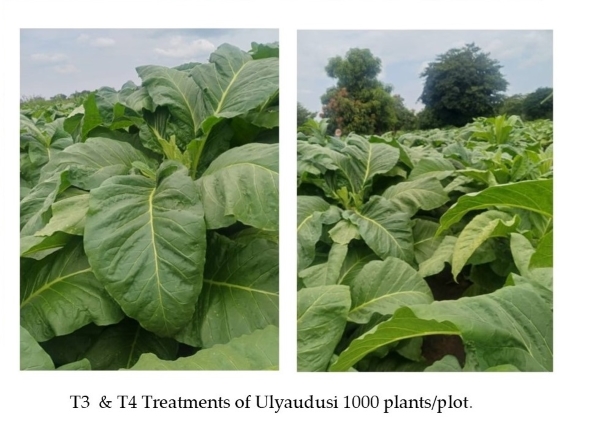
The standard treatment (T3), which received the full NPK rate of 30 g plant⁻¹ at 7 DAT, followed by top-dressing with CAN (27% N) at 8 g/plant produced significantly greater leaf length (55.61 ± 1.74 cm), leaf width (26.23 ± 0.82 cm), and leaf area of927.65 ± 58.30 cm² (Fig 1). This was followed by treatment T4 (Fig 2), which received reduced NPK fertilizer at 15 g plant⁻¹ at 7 DAT, followed by ROKO nano DAP foliar application at 21 DAT and ROKO nano-urea foliar application at 42 DAT. Treatment T4 recorded leaf length, width, and area values of 49.66 ± 1.66 cm, 22.40 ± 0.78 cm, and 707.63 ± 48.38 cm², respectively.
Table 4 presents the green and dry leaf yields from the 2,400 m2 plot (1000 plant per plot). The unfertilized treatment recorded the lowest green leaf yield (3930.36 ± 285.35 kg ha⁻¹) and dry leaf yield (707.46 ± 51.36 kg ha⁻¹). Treatment T2, which received NPK at 15 g plant⁻¹ at 7 DAT, followed by ROKO nano DAP foliar application at 14 DAT and ROKO nano-urea foliar applications at 35 and 49 DAT, produced green and dry leaf yields of 6306.24 ± 1.30 kg ha⁻¹ and 1240.22 ± 21.01 kg ha⁻¹, respectively. These yields were significantly lower than those obtained from treatment T1, which involved ROKO nano DAP drenching at 3 DAT, followed by ROKO nano DAP foliar application at 14 DAT and ROKO nano-urea foliar applications at 35 and 42 DAT. Treatment T1 produced green and dry leaf yields of 8383.35 ± 1.28 kg ha⁻¹ and 1505.40 ± 0.23 kg ha⁻¹, respectively.
The standard treatment (T3), which received NPK at 30 g plant⁻¹ at 7 DAT, followed by CAN (27% N) at 8 g/plant at 21 DAT, produced the highest green leaf yield (10105.35 ± 332.99 kg ha⁻¹) and dry leaf yield (1885.22 ± 54.78 kg ha⁻¹). However, these yields did not differ significantly from those obtained in treatment T4, which received NPK at 15 g plant⁻¹ at 7 DAT followed by ROKO nano DAP foliar application at 21 DAT and ROKO nano-urea foliar application at 42 DAT. Treatment T4 produced green and dry leaf yields of 9764.23 ± 2.44 kg ha⁻¹ and 1855.20 ± 56.39 kg ha⁻¹, respectively.
Table 4. Impact of ROKO nano DAP and ROKO nano-urea application on tobacco green leaf and dry leaf yield in 100 m x 24 m plot.
Treatments | Green leaf (kg/ha) | Dry leaf (kg/ha) |
T1 3DAT 30 mls drench ROKO nano DAP, 14DAT ROKO nano DAP foliar, 35 & 42 DAT ROKO nano-urea foliar | 8383.35 ± 1.28 b | 1505.40 ± 0.23 b |
T2 7DAT NPK 15g/plant, 14DAT ROKO nano DAP foliar, 35 & 49 DAT ROKO nano-urea foliar | 6306.24 ± 1.30 c | 1240.22 ± 21.01 c |
T3 standard 7DAT NPK 30g/plant, 21 DAT CAN 27% N 8g/plant | 10105.35 ± 332.99 a | 1885.22 ± 54.78 a |
T4 7DAT NPK 15g/plant, 21 DAT ROKO nano DAP foliar, 42DAT ROKO nano-urea foliar | 9764.23 ± 2.44 a | 1855.20 ± 56.39 a |
T5 unfertilized | 3930.36 ± 285.35 d | 707.46 ± 51.36 d |
One-WAY ANOVA F-statistics | | |
Treatment (T) | 173.14*** | 128.42*** |
4. Discussion
4.1. Impact of nano fertilizer on tobacco leaf yields in the first field 6 m x 6 m plot
The combined application of reduced basal NPK fertilizer with foliar ROKO nano DAP and ROKO nano urea improved tobacco leaf growth and yield compared to the unfertilized control and treatments that received nano-fertilizers. In the sandy soil area with a plot size of 36 m², treatment T1, which received 30 mL ROKO nano DAP through drenching at 3 DAT followed by NPK at 15 g/plant at 7 DAT and ROKO nano-urea foliar sprays at 21, 35, and 49 DAT, produced the highest leaf length (42.41 ± 2.02 cm), leaf width (16.95 ± 0.81 cm), and leaf area (458.21 ± 42.65 cm²), as presented in Table 1. These values were statistically comparable to treatment T3, which received NPK at 15 g/plant followed by ROKO nano urea foliar application, with leaf length, width, and area of 39.98 ± 2.64 cm, 16.32 ± 1.16 cm, and 417.94 ± 57.73 cm², respectively (Table 1). In contrast, treatment T2, which received ROKO nano DAP and ROKO nano-urea foliar applications without basal granular fertilizer, and the unfertilized treatment (T4) recorded the lowest values for leaf growth parameters. This suggests that the dilution of nano- fertilizers resulted in an insufficient nutrient supply during early crop establishment. Thus, the dilution rate of 4 mL of ROKO nano DAP and ROKO nano-urea per L of water may not be adequate for tobacco crops, hence a lower dilution rate of nano-fertilizers should be considered in the future.
The poor performance observed when ROKO nano DAP was applied alone through drenching at 3 DAT may be attributed to the limited root establishment immediately after transplanting, which could reduce nutrient absorption efficiency. Similarly, the foliar application of ROKO nano DAP within two weeks after transplanting was less effective because tobacco plants had insufficient leaf surface area and lower physiological demand at this stage for phosphorus and nitrogen. Therefore, the results indicate that ROKO nano DAP improved growth when applied three weeks after transplanting, whereas ROKO nano-urea showed growth improvement during the rapid vegetative growth stage between five and seven weeks after transplanting (Tables 1 and 2). Nitrogen is critically required during this period to support chlorophyll formation, leaf expansion, photosynthesis, and nicotine synthesis in tobacco leaves. However, the dilution rate of 4 mL used for both ROKO nano DAP and ROKO nano-urea per L of water could be considered increased to bring effective results as tobacco crop is a heavy feeder of nutrients.
The superior performance of T1 and T3 demonstrates the importance of integrating nano-fertilizers with basal NPK fertilizer. The application of NPK at 15 g plant⁻¹ likely promoted early root establishment and supplied essential macronutrients, including nitrogen (N), phosphorus (P), potassium (K), calcium (Ca), magnesium (Mg), sulphur (S), and boron (B), thereby creating favorable physiological conditions for the efficient utilization of foliar-applied nano nutrients. Similar findings were reported by Daware et al. [50], who observed that soybean treated with a combination of conventional basal fertilizer and foliar nano fertilizers produced significantly higher leaf area, biomass accumulation, and growth compared with nano fertilizer alone. Likewise, Reddy et al. [51] reported that the integration of basal fertilizer with nano-urea and nano DAP significantly improved the growth and yield of transplanted rice compared with the sole nano-fertilizer application.
The trends observed in leaf growth parameters were reflected in green and dry leaf yields in the sandy soil area with a plot size of 36 m² (Table 1). Treatment T1 produced green and dry leaf yields of 6808.60 ± 980.97 kg ha⁻¹ and 1361.72 ± 196.19 kg ha⁻¹, respectively, whereas treatment T3 produced 6684.34 ± 493.52 kg ha⁻¹ and 1336.87 ± 98.70 kg ha⁻¹, respectively. These yields were statistically similar to those of the standard fertilizer treatment (T5), which recorded green and dry leaf yields of 6843.21 ± 1060.45 kg ha⁻¹ and 1368.64 ± 292.09 kg ha⁻¹, respectively (Table 2). However, the unfertilized treatment (T4) recorded the lowest green and dry leaf yields of 2250.14 ± 189.54 kg ha⁻¹ and 510.02 ± 37.90 kg ha⁻¹, respectively. Treatment T2, which relied only on ROKO nano DAP and ROKO nano-urea foliar applications, also produced relatively low yields of 3803.43 ± 729.38 kg ha⁻¹ green leaf and 760.68 ± 145.87 kg ha⁻¹ dry leaf (Table 3). These findings indicate that nano-fertilizers alone cannot fully substitute basal granular fertilizers under the conditions of this study.
The increased green and dry leaf yields observed in T1 and T3 may be associated with improved nutrient- use efficiency, enhanced photosynthetic activity, and increased leaf expansion resulting from synchronized nutrient availability during critical growth stages. Nano fertilizers are known to provide nutrients in smaller particle sizes with a greater surface area, enhancing nutrient absorption and translocation within plant tissues. Similar results were reported by Ahari et al. [52], who found that the foliar application of nano-urea combined with basal fertilizer significantly increased green fodder and dry matter yields in forage sorghum. Comparable improvements in growth and yield due to nano-urea application were also reported in pearl millet by Vegda et al. [53].
4.2. Impact of nano-fertilizer on tobacco leaf yields in the second field 100 m x 24 m plot
In the 2,400 m2 plots, treatment responses differed slightly from those observed in the 36 m² ones. The standard treatment (T3), which received NPK at 30 g plant⁻¹ followed by CAN top-dressing, produced the highest leaf length (55.61 ± 1.74 cm), leaf width (26.23 ± 0.82 cm), and leaf area (927.65 ± 58.30 cm²), as shown in Table 3 and (Fig 1). However, treatment T4, which received reduced NPK at 15 g/plant followed by ROKO nano DAP and ROKO nano-urea foliar applications, also produced relatively high leaf growth values of 49.66 ± 1.66 cm leaf length, 22.40 ± 0.78 cm leaf width, and 707.63 ± 48.38 cm² leaf area (Fig 2). This suggests that the partial substitution of conventional fertilizer with nano-fertilizers can sustain satisfactory tobacco growth under field conditions. However, these results suggest that the dilution rate of ROKO nano DAP and ROKO nano-urea should be above 4 mL per L of water to achieve good growth results.

Similarly, the highest green and dry leaf yields in the 2,400 m2 plots were obtained from the standard treatment T3, with 10105.35 ± 332.99 kg ha⁻¹ green leaf yield and 1885.22 ± 54.78 kg ha⁻¹ dry leaf yield (Table 4). Nevertheless, treatment T4 achieved statistically comparable yields of 9764.23 ± 2.44 kg ha⁻¹ green leaf and 1855.20 ± 56.39 kg ha⁻¹ dry leaf, despite receiving only half of the basal NPK rate. This demonstrates that nano-fertilizers can partially supplement the conventional fertilizer requirements without significantly reducing tobacco productivity. Similar observations were reported by Gousia et al. [54], who found that foliar nano-urea combined with reduced conventional fertilizer-maintained cotton yield comparable to the full recommended fertilizer dose.
In contrast, treatment T2 in the 2,400 m2 (1000 plants per plot) produced significantly lower green and dry leaf yields (6306.24 ± 1.30 kg ha⁻¹ and 1240.22 ± 21.01 kg ha⁻¹, respectively) compared with T1, despite receiving similar foliar nano-fertilizer applications (Table 4). The lower performance may be associated with one of the treatment T2 having environmental effects, particularly termite infestation observed in one of the plot, which caused plant lodging and likely reduced nutrient uptake efficiency and biomass accumulation. Environmental and soil factors are known to influence the efficiency of nano-fertilizers because nutrient uptake depends on plant physiological status, soil moisture, and root health [55]. In addition, it was reported that the curing tobacco under treatment T2 experienced challenges due to the longer time required to cure the leaves. This was attributed to the high inherent soil fertility in one of the plots and the foliar application of tobacco at 49 weeks after transplanting, which is not recommended, as the nitrogen (N) levels in the leaves could have been excessively high. Consequently, the drying time of the tobacco leaves was prolonged, and some leaves were lost due to their poor quality. The soils used for the nano-fertilizer trials had good fertility status based on the natural vegetation and soil color. Our trial was a pilot study conducted in a single season and in one location, we recommend further trials to be carried out in purely sandy soils and to determine the initial fertility status before transplanting tobacco seedlings.
Overall, the present findings indicate that tobacco seedlings require a moderate basal application of granular NPK fertilizer to establish adequate crop stands and support early physiological development. Subsequent foliar application of ROKO nano DAP and ROKO nano-urea during active vegetative growth stages can effectively enhance leaf expansion, biomass accumulation, and cured-leaf yield. The results further suggest that nano-fertilizers are more effective as supplements rather than complete replacements for conventional fertilizers in tobacco production systems. The current study recommends further research across at least three tobacco-growing ecological zones with different soil types to assess additional parameters, such as tobacco leaf nutrient concentrations, nutrient uptake, reducing sugar content, nicotine content, and grade index. Soil fertility status should also be determined before and after research trials, as these important agronomic parameters were not evaluated in the current study. Assessing these parameters will provide a better understanding the influence of nano-fertilizers on tobacco growth, yield, and leaf quality, thereby enabling more comprehensive and conclusive research findings.
5. Conclusions and recommendation
The study demonstrated that the integration of ROKO nano DAP and ROKO nano-urea with reduced basal NPK fertilizer improved tobacco leaf growth and yield compared with unfertilized treatments and nano- fertilizer application alone. In both the 36 m² and 2400 m2 plots, treatments combining basal NPK with foliar nano fertilizers produced higher leaf length, leaf width, leaf area, green leaf yield, and dry leaf yield, with performances comparable to or approaching the standard conventional fertilizer treatment. The findings indicate that nano fertilizers are more effective when used as supplements to basal granular fertilizers rather than as complete substitutes, particularly during critical vegetative growth stages.
A reduced basal NPK application of 15 g/plant combined with a foliar application of ROKO nano DAP and ROKO nano-urea is recommended for tobacco production to improve nutrient-use efficiency while maintaining satisfactory leaf yield and growth performance. The foliar application of ROKO nano DAP is recommended from three weeks after transplantation, whereas ROKO nano-urea application is most effective between the fifth and sixth weeks after transplantation during rapid vegetative growth. Thus, the foliar ROKO nano-fertilizer should not be applied for more than 42 weeks after transplantation. A limitation of the current study is that it was conducted at a single site and for one season, which may limit the generalizability of the findings to different agro-ecological conditions. In addition, soil fertility status was not assessed before and after the trial, limiting the ability to evaluate the effects of fertilizer treatments on soil nutrient dynamics. Hence, further studies are recommended across different agro-ecological zones and seasons to validate the consistency of nano-fertilizer performance under varying environmental conditions, while also considering lower dilution rates of ROKO nano DAP and ROKO nano-urea for tobacco crops. Future studies should also include the determination of tobacco leaf nutrient concentrations, nutrient uptake, reducing sugars, nicotine content, and grade index to understand the factors contributing to tobacco leaf growth, yield, and quality in response to granular and nano fertilizers. This would provide more comprehensive and conclusive results regarding the effectiveness of these fertilizers.
Disclaimer (artificial intelligence)
Author(s) hereby state that no generative AI tools such as Large Language Models (ChatGPT, Copilot, etc.) and text-to-image generators were utilized in the preparation or editing of this manuscript.
Authors’ contributions
Conceptualization, methodology, formal analysis, funding acquisition, investigation, data curation, manuscript writing original draft, review, editing, visualizing, and validation of the final manuscript, J.L; methodology, investigation, supervision, resources, data curation, manuscript review and editing, software, validation of the final manuscript, M.N.; methodology development, supervision of casual laborers, data curation, formal analysis, review and editing of manuscript, software, visualizing and validation of the final manuscript, R.K.
Acknowledgements
The authors acknowledge the tobacco field staff and curing technicians of TORITA for their close implementation of the research protocol at TORITA, Tumbi, headquarter in Tabora Region Acknowledgements are further extended to the Researchers of TORITA for field supervision, data collection and writing the manuscript. Lastly, we acknowledge the ROKO Agro Private Limited of Dar es Salaam, Tanzania for providing ROKO nano-urea and ROKO nano DAP products of IFFCO - India's largest Agro Fertilizer Manufacturers and Distributor Company.
Funding
Research fund for this research was funded by grants from ROKO Agro Private Limit located in Dar es Salaam, Tanzania through code 996690003451. The open access funding was funded by TORITA.
Availability of data and materials
All data will be made available on request according to the journal policy.
Conflicts of interest
The authors declare no conflict of interest.
References
1. | Fathi, A. Role of nitrogen (N) in plant growth, photosynthesis pigments, and N use efficiency: A review. Agrisost 2022, 1025-0247, 28, 1-8. https://doi.org/10.5281/zenodo.7143588 |
2. | Hassan, A.; Gulzar, S.; Nawchoo, I.A. Role of nitrogen in photosynthesis. In Advances in plant nitrogen metabolism. 2022, 86-95. CRC Press. https://doi.org/10.1201/9781003248361-7 |
3. | Yadav, R.; Parshuram, P.; Singh, S.; Reddy, M.S.S.; Kunjam, S. Effect of nitrogen on crop production. Int. J. Res. Agronom. 2025, 8(5), 350-354. https://doi.org/10.33545/2618060X.2025.v8.i5e.2909 |
4. | Liu, H.; Gao, X.; Fan, W.; Fu, X.; Optimizing carbon and nitrogen metabolism in plants: From fundamental principles to practical applications. J. Integr. Plant Biol. 2025, 67(6), 1447-1466. https://doi.org/10.1111/jipb.13919 |
5. | Upadhyay, P.K.; Dey, A.; Singh, V.K.; Dwivedi, B.S.; Singh, T.; GA, R.; Babu, S.; Rathore, S.S.; Singh, R.K.; Shekhawat, K.; Rangot, M. Conjoint application of nano-urea with conventional fertilizers: An energy efficient and environmentally robust approach for sustainable crop production. Plos One. 2023, 18(7), e0284009. https://doi.org/ 10.1371/journal.pone.0284009 |
6. | Liu, J.; Wang, H.; Penuelas, J.; Mou, J.; Delgado-Baquerizo, M.; Sardans, J.; et al. Global-scale prevalence of low nutrient use efficiency across major crops. Nature Commun. 2025, 16(1), 11036. https://doi.org/10.1038/s41467-025-66019-w |
7. | Yang, J.; Lin, P.; Liu, Q.; Xia, Y.; Zhao, W.; Wang, D.; et al. From major crops to sugarcane: Rethinking nitrogen use efficiency for a sustainable future. Plant Physiol. Biochem. 2026, 111170. https://doi.org/10.1016/j.plaphy.2026.111170 |
8. | Mlay, D.P.; Lisuma, J.B. Assessing the potential of irrigating against rainfed Manihot Esculenta Crantz under different levels of NPK fertilizers on storage root yields in Tanzania Lake Victoria zone. J. Mod. Agric. Biotechnol. 2022, 1(2). https://doi.org/10.53964/jmab.2022010 |
9. | Lisuma, J.B.; Mrema, E.J.; Mbwambo, A.F. Assessing the effects of fertilizer applied to soils with different soil organic carbon on sorghum (Sorghum bicolor L.) Moench, Yields. J. Mod. Agric. Biotechnol. 2022, 1(1), 4. https://doi.org/10.53964/jmab.2022004 |
10. | Saeed, Z.; Habib, H.; Noor, A.; Gohar, A.; Waqar, M. Urea fertilizer: A journey from an essential nutrients to an emerging pollutant. Pak. J. Chem. 2025, 15. https://doi.org/10.15228/2025.v15.i1-2.p04 |
11. | Revathi, J.; Vishnoi, M.; Jamakhandi, H.; Raina, S.; Bharathie, S.B.; Patyal, D.; et al. Nitrogen fertilizers and climate change: A comprehensive review of greenhouse gas emissions and sustainable management. Int. J. Environ. Climate Change. 2025, 15(8), 430-443. https://doi.org/10.9734/ijecc/2025/v15i84986 |
12. | Ejigu, D.; Pushpalatha, R.; Jayaprakash, S.K.; Gangadharan, B.; Himanshu, S.K.; Gopakumar, S. Integrated fertilizers for sustainable wheat production to improve food security—A comprehensive review. J. Plant Nutr. Soil Sci. 2025, 188(1), 5-16. https://doi.org/10.1002/jpln.202400213 |
13. | Lisuma, J.B.; Muna, E.I.; Gama, G.V.; Kisoka, R.P.; Maerere, E.S.; Meliyo, J.L.; et al. Impact of FOMI organo-mineral fertilizers on pH and organic carbon of the soils under tobacco (Nicotiana tabacum L) production in Tanzania. J. Agric. Food Sci. Biotechnol. 2026, 4(1), 30-37, 2026. https://doi.org/10.58985/jafsb.2026.v04i01.89 |
14. | Craswell, E. Fertilizers and nitrate pollution of surface and ground water: an increasingly pervasive global problem. SN Appl. Sci. 2021, 3(4), 518. https://doi.org/10.1007/s42452-021-04521-8 |
15. | Hossain, M.E.; Shahrukh, S.; Hossain, S.A. Chemical fertilizers and pesticides: impacts on soil degradation, groundwater, and human health in Bangladesh. In Environmental Degradation: Challenges and Strategies for Mitigation. pp.63-92, 2022. https://doi.org/10.1007/978-3-030-95542-7_4 |
16. | Kumar, A.; Ram, H.; Kumar, S.; Kumar, R.; Yadav, A.; Gairola, A.; et al. A comprehensive review of nano-urea vs. conventional urea. Int. J. Plant Soil Sci. 2023, 35(23), 32-40. https://doi.org/10.9734/IJPSS/2023/v35i234212 |
17. | Saha, B.; Fatima, A.; Saha, S.; Sahoo, S.K.; Poddar, P. Environmental pollution due to improper use of chemical fertilizers and their remediation. In Environmental Contaminants. pp.203-219, 2024. Apple Academic Press. https://doi.org/10.1201/9781003412236-8 |
18. | Ali, A.M. Environmental pollution and climate change implications of agricultural fertilizer use. In Agricultural Nutrient Pollution and Climate Change: Challenges and Opportunities. pp.1-28, 2025. Cham: Springer Nature Switzerland. https://doi.org/10.1007/978-3-031-80912-5_1 |
19. | González-González, J.L.; Vargas-Pérez, M.P.; Luna-Olvera, H.A.; Martínez-Amador, S.Y.; Morales-Martínez, T.K.; Ríos-González, L.J.; et al. Microalgae Biofertilizers Versus Chemical Fertilizers: Environmental and Agricultural Perspectives. The Potential of Biotechnology and Bioproducts in the Implementation of the Sustainable Development Goals. pp.91-110, 2026. https://doi.org/10.1007/978-3-032-10314-7_6 |
20. | Mittal, V.K. Russia-Ukraine War: A Quantitative Analysis of Global Fertilizer Supply Chains & Investment Opportunities. Authorea Preprints, 2025. |
21. | Mishra, V.; Sharma, P.; Khound, K.; Mishra, V.; Sharma, P.; Khound, K. Global supply chain shocks and trade resilience: A review post-covid and Ukraine crisis. J. Market. Soc. Res. 2025, 2, 336-348. https://doi.org/10.61336/jmsr/25-05-38 |
22. | Buheji, M. The spillover effects of gulf conflict on global food production: A sustainability analysis of fertilizer supply chain disruptions. Int. J. Sci. Architect. Technol. Environ. 2026, 3(3), 913-931. https://doi.org/10.63680/ijsate0326093.083 |
23. | Hebebrand, C.; Glauber, J.; Vos, R.; Rice, B. The Iran war’s impacts on global fertilizer markets and food production. IFPRI Blog, 1, 2026. |
24. | Guo, H.; White, J.C.; Wang, Z.; Xing, B. Nano-enabled fertilizers to control the release and use efficiency of nutrients. Curr. Opin. Environ. Sci. Health. 2018, 6, 77-83. https://doi.org/10.1016/j.coesh.2018.07.009 |
25. | Iqbal, M.; Umar, S.; Mahmooduzzafar, F. Nano-fertilization to enhance nutrient use efficiency and productivity of crop plants. Nanomaterials and Plant Potential. pp.473-505. 2019. Cham: Springer International Publishing. https://doi.org/10.1007/978-3-030-05569-1_19 |
26. | Yadav, A.; Yadav, K.; Abd-Elsalam, K.A. Nanofertilizers: types, delivery and advantages in agricultural sustainability. Agrochem. 2023, 2(2), 296-336. https://doi.org/10.3390/agrochemicals2020019 |
27. | Nawadkar, A.; Chaskar, J.; Tiwari, A.; Chaskar, A. Controlled release of nanofertilizers: A promising approach for efficient delivery of nutrients in plants. J. Crop Improv. 2024, 38(3), 189-218. https://doi.org/10.1080/15427528.2024.2336259 |
28. | Kantwa, S.; Yadav, L.R. nano urea: Applications and significance. Just Agric. 2022, 2(7),1-6. |
29. | Munjal, R.; Bhatia, Y.; Rana, V. Green chemistry strategies in the development of sustainable multi-nutrient fertilizers for enhanced soil and crop health. Agrochem. 2026, 5(2), 21. https://doi.org/10.3390/agrochemicals5020021 |
30. | Khattak, W.A.; Majeed, M.; Soylu, S.; Farid, A.; Riaz, S.; Anas, M.; et al. Development of Nanofertilizers for Soil Health and Fertility. Nanotechnology Innovations for Food Security and Sustainable Agriculture. 43-64, 2026. https://doi.org/10.1002/9781394349012.ch3 |
31. | Qadri, T.A.; Khan, A.; Khan, R.A.; Maaza, M.; Batool, R.; Nazir, R.; et al. Nanofertilizers for sustainable agriculture: Mechanisms, benefits, and environmental challenges. BioNanoSci. 2026, 16(3), 164. https://doi.org/10.1007/s12668-025-02370-y |
32. | Karn, N.; Kumar, A.; Ikram, M.; Sachan, S.; Singh, J.; Kumar, S.; et al. Enhancing agronomic crop performance: A review of the role of nano-diammonium phosphate (nano-DAP) in improving soil nutrient status and crop productivity. Sains Tanah-J. Soil Sci. Agroclimat. 2025, 22(2), 349-358. https://doi.org/10.20961/stjssa.v22i2.103576 |
33. | Sharma, S.; Raj, P.; Singh, K.; Raj, A.; Ahirwar, S.; Manzoor, U.; et al. Nano fertilizer in modern agriculture, a sustainable approach for enhanced crop productivity and soil health: A brief review. J. Sci. Res. Rep. 2026, 32(2), 298-317. https://doi.org/10.9734/jsrr/2026/v32i23980 |
34. | Bhaurao, T.B. Nitrogen management in kharif maize (Zea mays L.) with nano urea foliar spray. M.Sc. (Agri.) thesis, 2022. Vasantrao Naik Marathwada Krishi Vidyapeeth, Parbhani, Maharashtra, India. |
35. | Jakhar, P.; Sankhala, K.; Plappally, A.K. Nanomaterials in the Agriculture Industry: Innovative Solutions for Sustainable Farming and Nutrition. In Nanomaterials: Synthesis and Applications. pp.247-271, 2026. Singapore: Springer Nature Singapore. https://doi.org/10.1007/978-981-95-7912-9_11 |
36. | Dhariwal, N.; Chahar, M.; Yadav, P.; Kumar, V. Nanotechnology in Agriculture: A New Frontier. In Smart Technologies for Transforming Next-Generation Agriculture: Deep Learning, IoT and Blockchain. pp.79-100, 2026. Bentham Science Publishers. https://doi.org/10.2174/97988988119211260101 |
37. | Avila-Quezada, G.D.; Ingle, A.P.; Golińska, P.; Rai, M. Strategic applications of nano-fertilizers for sustainable agriculture: Benefits and bottlenecks. Nanotechnol. Rev. 2022, 11(1), 2123-2140. https://doi.org/10.1515/ntrev-2022-0126 |
38. | Channab, B.E.; Idrissi, A.E.; Ammar, A.; Dardari, O.; Marrane, S.E.; El Gharrak, A.; Akil, A.; Essemlali, Y.; Zahouily, M. Recent advances in nano-fertilizers: synthesis, crop yield impact, and economic analysis. Nanoscale. 2024, 16(9), 4484-4513. https://doi.org/10.1039/D3NR05012B |
39. | Hoa, B.T. Recent advances in nano-fertilizers: synthesis strategies, mechanistic insights, environmental implications, and emerging applications for enhancing nutrient use efficiency in sustainable agriculture systems. Asian J. Appl. Sci. Technol. 2026, 10(1), 201-209. https://doi.org/10.38177/ajast/2026.10117 |
40. | Alimohammadi, M.; Panahpour, E.; Naseri, A. Assessing the effects of urea and nano-nitrogen chelate fertilizers on sugarcane yield and dynamic of nitrate in soil. Soil Sci. Plant Nutr. 2020, 66(2), 352-359. https://doi.org/10.1080/00380768.2020.1727298 |
41. | Hoque, M.R.; Khan, M.S.H. Greater growth and yield response of nano urea with conventional urea for potato (Solanum tuberosum) cultivation. Int. J. Biol. Eng. Agric. 2024, 3(3), 378-385. |
42. | Munir, J.; Nazim, M.; Jabeen, N.; Ali, M.; Shah, A.A.; Sultan, H. Synergistic role of foliar-applied nano-fertilizers enhances drought tolerance in cluster bean (Cyamopsis tetragonoloba L.). Plant Nano Biol. 2025, 100185. https://doi.org/10.1016/j.plana.2025.100185 |
43. | Shoukat, A.; Saqib, Z.A.; Nawaz, A.; Amir, K.Z.; Ahmad, I.; Hamza, A.; et al. Nanofertilizers benefited maize to cope oxidative stress under saline environment. Plant Nano Biol. 2025, 11, 100141. https://doi.org/10.1016/j.plana.2025.100141 |
44. | Mehdizadeh, M.; Omidi, A.; Al-Taey, D.K.; Choudhury, A.R. Effect of Nanofertilizers on Plant’s Stress-Tolerance. In Nanofertilizers in Agriculture: Synthesis, Mechanisms, and Effect on Plants. pp.435-458, 2025. Cham: Springer Nature, Switzerland. https://doi.org/10.1007/978-3-031-78096-7_18 |
45. | Jangir, N.; Marik, D.; Verma, D.; Dey, A.; Shekhawat, R.S.; Patel, D.; et al. Nano urea outperforms equimolar bulk urea in the hydroponic growth of Arabidopsis thaliana by inducing higher levels of nitrogen assimilation and chlorophyll biosynthesis genes. J. Plant Growth Reg. 2025, 44(6), 2865-2891. https://doi.org/10.1007/s00344-024-11581-8 |
46. | Chen, L.; Hu, H.; Song, Z.; Yang, J.; Ge, C.; Dong, L.; et al. Effects of foliar application of carbon nanosol on growth of potted tobacco seedlings. J. Henan Agric. Sci. 2024, 53(8), 44. https://doi.org/10.15933/j.cnki.1004-3268.2024.08.005 |
47. | Neeruggi, R.; Nayaka, K.S. Effect of nano DAP and urea on growth, yield and quality of chilli (Capsicum annuum L.). Master of Science (Horticulture) thesis, 2024. University of Agricultural and Horticultural Sciences Shivamogga. |
48. | Lisuma, J.; Mbega, E.; Ndakidemi, P. Influence of tobacco plant on macronutrient levels in sandy soils. Agronom. 2020, 10(3), 418. https://doi.org/10.3390/agronomy10030418 |
49. | Lisuma, J.B.; Mbwambo, A.F. The effects of blended N10P18K24 fertilizer on agronomic performance tobacco (Nicotiana tabaccum L) plant and quality of flue cured tobacco leaf. Tanzania J. Agric. Sci. 2024, 22(2), 300-308. |
50. | Daware, N.A.; Potkile, S.N.; Sarak, S.R.; Deshmukh, K.Y.; Chavan, R.V. Effect of application of nano urea and nano DAP on growth characters of soybean (Glycine max L.). Int. J. Res. Agron. 2024, 7(11), 330-334. https://doi.org/10.33545/2618060X.2024.v7.i11e.1988. |
51. | Reddy, K.; Ramesha, Y.M.; Krishnamurthy, D.; Shankar, K.A.; Swamy, M. Effect of nano urea and nano DAP on growth, yield and economics of transplanted rice. Int. J. Res. Agron. 2024, 7, 155-158. https://doi.org/10.33545/2618060x.2024.v7.i10sc.1717 |
52. | Ahari, P.; Choudhary, J.; Kaushik, M.K.; Meena, S.C.; Rawal, P. Effect of foliar application of nano urea and nano DAP on growth and yield of forage sorghum (Sorghum bicolor L. Moench). Int. J. Res. Agron. 2024, 7(7), 140-143. https://doi.org/10.33545/2618060X.2024.v7.i7b.99 |
53. | Vegda, S.N.; Bhuva, H.M.; Chauhan, P.N.; Dodiya, K.J.; Vekariya, S.N. Effect of foliar application of nano urea on growth, yield and profitability of summer pearl millet (Pennisetum glaucum L.). Int. J. Res. Agron. 2024, 7 (Special Issue 8), 16-20. https://doi.org/10.33545/2618060X.2024.v7.i8Sa.1216 |
54. | Gousia, S.U.; Ajayakumar, M.Y.; Krishnamurthy, D.; Shankar, A.K.; Bhat, S.N. Effect of nano nitrogen on growth, yield and nutrient uptake of Bt cotton. Int. J. Environ. Climate Change. 2023, 13(11), 3705-3710. https://doi.org/10.9734/ijecc/2023/v13i113550 |
55. | Rasel, M.A.; Salam, S.; Islam, M.M. Nano-fertilizers for climate-smart agriculture: resource efficiency across soil-plant-environment systems. Climate Smart Agric. 2026, 100115. https://doi.org/10.1016/j.csag.2026.100115 |

This work is licensed under the
Creative Commons Attribution
4.0
License (CC BY-NC 4.0).
Abstract
The rising cost of conventional granular fertilizers
has become a major constraint in tobacco production, limiting fertilizer
accessibility and reducing profitability for smallholder farmers. Nano-fertilizers
offer a potential option for reducing dependence on conventional fertilizers
while maintaining the crop performance. This pilot study assessed the potential
of ROKO nano DAP and ROKO nano-urea to supplement reduced rates of conventional
NPK fertilizer in tobacco production. Field experiments were conducted using 36
m² research plots and 2,400 m² demonstration plots under treatments comprising ROKO
Nano DAP, ROKO nano-urea, reduced NPK rates, the recommended NPK rate, and an
unfertilized control. The data collected included leaf area, green leaf yield,
and dry leaf yield. Integrating reduced basal NPK fertilizer (15 g plant⁻¹)
with ROKO nano DAP and ROKO nano-urea significantly improved leaf growth and
yield compared to the unfertilized control and nano fertilizers applied alone.
In the 36 m² plots, the treatment combining ROKO nano DAP drench, reduced NPK
fertilizer, and ROKO nano urea foliar application (T1) produced the highest
leaf area (458.21 cm²), green leaf yield (6,808.60 kg ha⁻¹), and dry leaf yield
(1,361.72 kg ha⁻¹), which were comparable to those of the standard fertilizer
treatment. In the 2,400 m² plots, the treatment combining reduced NPK
fertilizer with ROKO nano DAP and ROKO nano-urea applications (T4) achieved
green and dry leaf yields of 9,764.23 and 1,855.20 kg ha⁻¹, respectively, which
were statistically similar to the standard fertilizer treatment. This pilot
study demonstrated that ROKO nano DAP and ROKO nano-urea can complement the reduced
rates of conventional NPK fertilizer without significant yield penalties in
tobacco production. However, further research needs to be conducted in the
three tobacco ecological zones to conclude the research while considering the determination
of leaf reducing sugars, grade index, and nicotine, but also to assess the soil
fertility status before and after the trials for determining the contributing
factors to tobacco growth, yield and quality in response to basal granular and
nano foliar fertilizers to provide conclusive results regarding the effectiveness
of these fertilizer types.
Abstract Keywords
Nano fertilizer, tobacco, ROKO nano DAP, ROKO nano-urea,
foliar application.
This work is licensed under the
Creative Commons Attribution
4.0
License (CC BY-NC 4.0).
Editor-in-Chief


This work is licensed under the
Creative Commons Attribution 4.0
License.(CC BY-NC 4.0).